

Recruiting Software for Agencies: Australian Government ICT
Recruiting software for agencies tailored to Australian government ICT needs. Streamline hiring, meet compliance, and fill roles faster with our proven
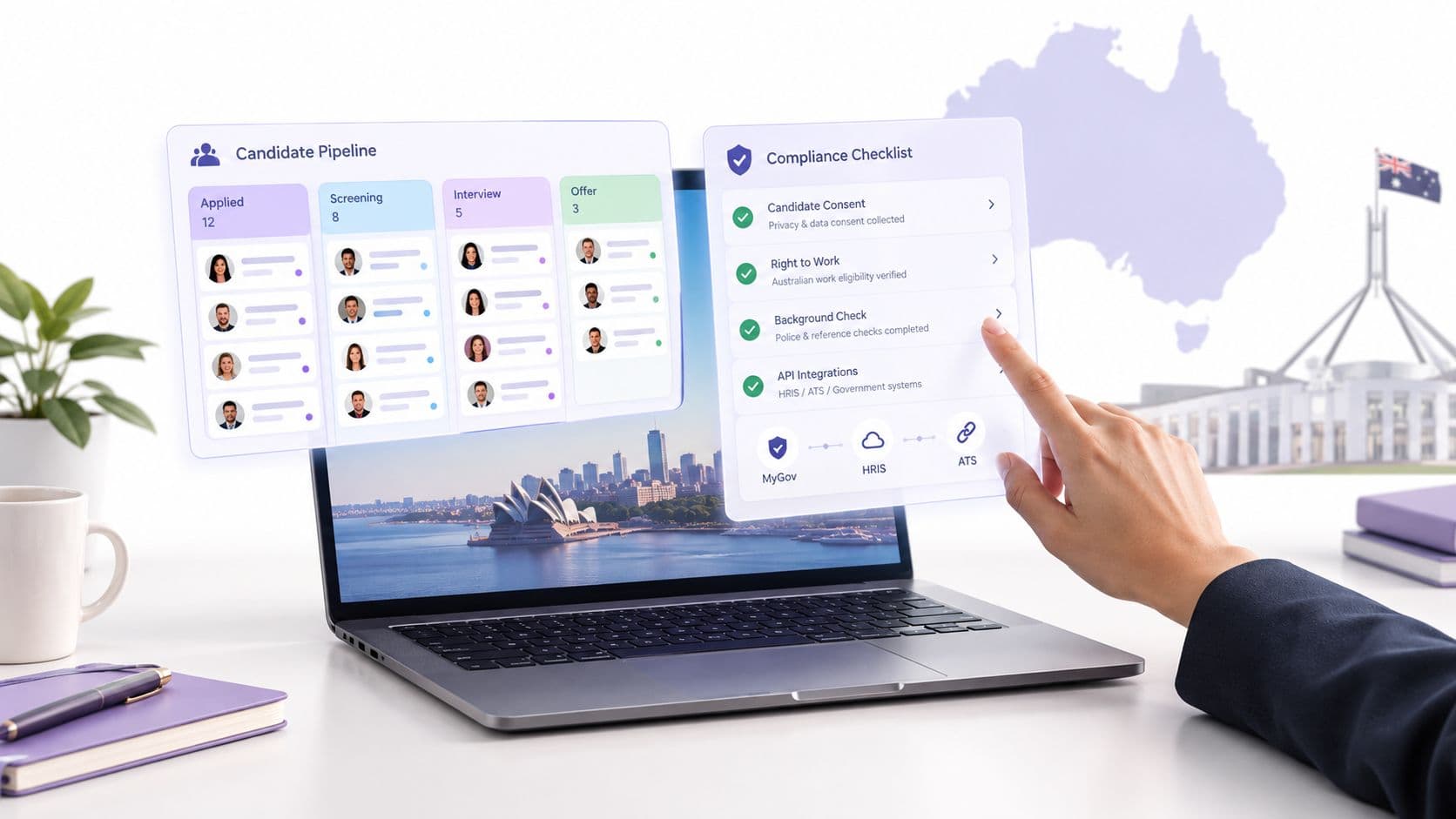
32% of IT-industry employers recruited in 2025–26, and that figure changes the way agency leaders should think about recruiting software for agencies in Australian Government ICT. The problem is no longer a simple shortage story. It's a selection problem, where the right platform has to link a public job ad back to a procurement record, hold clearance evidence, and defend every shortlist decision with traceable fields from the source opportunity Jobs and Skills Australia.
- Capability — Procurement-aware suites — BuyICT-specialist tools — Generic ATS + API — CRM-led workflows
- Procurement linkage — Treats opportunity records as first-class objects, with ad-to-contract traceability — Strong on BuyICT and panel mapping, less broad outside that channel — Usually stores the ad, not the procurement context — Often attaches procurement notes to a client record
- Multi-user workspace depth — Shared candidate cache, role-based access, stage control — Usually built around opportunity tracking and review queues — Strong candidate pipeline, weaker procurement context — Strong contact history, weaker pipeline discipline
- Pipeline kanban — Usually includes unqualified to placed, with review states — Often ties stages to opportunity status and close dates — Standard ATS stages, little procurement logic — Pipeline exists, but it's client-centric
- Consent gate — Built to block submission before approval — Often included as a compliance step — Sometimes configurable, often manual — Usually needs custom workflow design
- CV scoring with evidence — Transparent scoring and source fields — Evidence-backed matching against live opportunity records — Keyword or similarity scoring, often opaque — Enrichment-heavy, but not always evidence-led
- CRM integration — Deep integration both ways — Often focused on reporting and alerts — Broad API coverage, but generic objects — Native strength, but opportunity detail can be thin
- API access — Opportunity-grade APIs, match evidence, and status updates — Focused APIs for procurement records and alerts — Good connectivity, weaker semantics — Good CRM APIs, weaker procurement context
- Live alert quality — Threshold alerts by marketplace, role, and status — Alerts tied to BuyICT change history — Basic alerts on saved searches — Campaign alerts, not procurement alerts
Australian Government ICT hiring behaves differently because the market is tied to procurement machinery, not just a vacancy feed. In 2025–26, 34% of recruiting IT employers received at least 20 applicants per vacancy, while only 16% expected to increase staffing in the next three months, which means agencies are dealing with crowded funnels and cautious hiring at the same time Jobs and Skills Australia. That combination rewards platforms that can separate signal from noise.
The practical question is whether a system treats the procurement record as the anchor, or just as metadata appended to a CV. In Australian Government ICT, that difference shapes everything from alerting to shortlist defensibility. A recruiter may find a plausible candidate, but without the right panel, buyer, clearance, and timing context, the submission can still miss the mark.
Practical rule: if the platform can't show the source opportunity behind each recommendation, it's fast search software, not procurement-aware recruiting software.
For a recruiter who wants to build agency credibility around this category, build agency authority on LinkedIn is a useful companion read because it shows how evidence-led positioning travels beyond the ATS.
Table of Contents
- Why Australian Government ICT Recruiting Is Not Generic Hiring
- How Australian Government ICT Procurement Works
- Platform Categories Compared Side by Side
- Multi-User Workspaces and Pipeline Management
- Consent, Clearance and Compliance Workflows
- API, CRM and Reporting Integration
- Evidence-Based Scoring Against APS Job Families
- Matching Platforms to Real Agency Scenarios
Why Australian Government ICT Recruiting Is Not Generic Hiring
Government ICT hiring is a procurement market first. Jobs and Skills Australia notes that 32% of IT-industry employers recruited in 2025–26, below 49% across all industries, while IT employed about 376,100 people in February 2026 and ICT professionals made up about 48% of that workforce Jobs and Skills Australia. Those figures point to a crowded, selective market, but agency software still has to solve a different problem. Australian Government ICT work adds procurement, panel and clearance constraints that a standard tech desk never encounters.
Procurement changes the unit of work
A private-sector hiring manager can post a role, review applicants and choose a shortlist. In government ICT labour hire, the recruiter often works from a panel arrangement, a buyer need and a documented opportunity. BuyICT's market structure, together with the APS Job Family Framework, means the workflow starts with structured requirements, not a free-text wish list.
The same logic applies to public-facing ads. A recruiter cannot rely on a loose keyword match and assume the ad sits cleanly inside a general ATS. The platform has to connect the live opportunity to the buyer's language, the role alias and the evidence needed to justify a submission.
Clearance and timing reshape fit
Government ICT also introduces the security layer. Baseline, NV1 and NV2 are different access levels, and the worker cannot self-sponsor a clearance AGSVA Security Clearance Applicant Guide Book. That creates three separate states the platform needs to record, eligibility, sponsorship and already-held clearance.
A candidate who looks perfect on paper can still miss the role if the platform never captured the required clearance status, location or start date.
A procurement-aware recruiting stack has to preserve that context from the first search through to submission. If it cannot show the source opportunity behind each recommendation, it is fast search software, not a system built for government ICT hiring.
For a recruiter who wants to build agency credibility around this category, build agency authority on LinkedIn is a useful companion read because it shows how evidence-led positioning travels beyond the ATS.
How Australian Government ICT Procurement Works
BuyICT is the operating environment, not merely a directory. Its market-insights page shows 24,095 contracts, $19.62 billion in reported contract value, and $5.72 billion awarded to SMEs across active marketplaces, panels and whole-of-government arrangements BuyICT market insights. That scale is why agency software has to filter by marketplace, buyer, role category, geography, closing time and status, not just by title.
The procurement chain matters
Digital Marketplace Panel 2 includes a dedicated ICT Labour Hire module and is open to a wide range of government buyers, including federal, state, territory and local-government entities, universities and government-owned corporations Digital Marketplace Panel 2. The same source also notes a 0.5% central administration fee. Those details are not background trivia. They define the channel, the buyer base and the commercial path.
A recruiter who sees only a job title can easily target the wrong supplier or the wrong submission path. A recruiter who sees the opportunity record, the panel context and the agency advertisement can make a defensible call. That is the difference between being busy and being accurate.
For a closer look at how invitation-only panels shape access and submission rights, see government ICT contracts and invitation-only processes.
The APS Job Family Framework is the taxonomy buyers use to define roles, aliases, specialisations, skills, capabilities and knowledge for ICT Labour Hire requirements APS Job Family Framework. A platform that cannot normalise CV evidence against those fields is missing the structure the market already uses.
A useful evaluation habit is to keep a short glossary in the team workspace. Buyer, seller, invitation posture, delivery state, working arrangement and clearance should all mean the same thing to every recruiter, otherwise the system will look organised while the work drifts.
Platform Categories Compared Side by Side
The category mistake agencies make is comparing a procurement-aware platform to a generic ATS as if they solve the same job. They don't. One is built to carry an opportunity through a panel-heavy process, the other is built to manage candidates after sourcing has already happened.
- Capability — Procurement-aware suites — BuyICT-specialist tools — Generic ATS + API — CRM-led workflows
- Procurement linkage — Native link from contract to ad, buyer and role — Strong BuyICT mapping and alerts — Manual field mapping or custom objects — Usually stored as notes or tags
- Multi-user workspace depth — Shared workspace with role separation — Team alerting and review queues — Basic shared folders or requisitions — Strong contact sharing, weaker role control
- Pipeline kanban — End-to-end, from unqualified to placed — Opportunity-centric, often narrower — Standard hiring stages — Project-style boards, not placement-specific
- Consent gate — Built into submission workflow — Usually included as compliance logic — Often custom-built — Often externalised to forms or tasks
- CV scoring with evidence — Matching tied to role fields and source evidence — Opportunity-aware matching — Generic score or similarity index — CRM enrichment without deep role scoring
- CRM integration — Deep, bidirectional and reporting-ready — Focused on opportunity and alert data — Broad API connectivity — Native CRM first, recruitment second
- API access — Opportunity-grade API objects — Useful for BuyICT and alerts — Strong technical access, weaker semantics — Good CRM APIs, weak procurement objects
- Live alert quality — Threshold alerts and rescore on change — Strong on new and changed opportunities — Keyword alerts only — Campaign alerts, not market alerts
The split is not feature count, it's workflow orientation. Procurement-aware suites and BuyICT tools understand that a candidate can only be matched against a live opportunity if the role evidence, timing and compliance fields still line up. Generic ATS platforms often handle the admin neatly but leave the procurement logic to the recruiter's memory.
CRM-led workflows sit in the middle. They're useful for relationship history, but they can underperform when the opportunity changes and the system doesn't rescore against the new record. That is why the weakest rows in the table are usually procurement linkage and live alert quality.
If your current stack can't tell you which opportunity changed, it can't tell you whether your shortlist is still relevant.
That's also why the right comparison metric is not “does it have a CRM”. It's “does it preserve the procurement story well enough to support a submission”. Once you use that test, the categories stop looking interchangeable.
Multi-User Workspaces and Pipeline Management
Australian Government ICT work breaks brittle shared tools fast. Multiple recruiters can touch the same opportunity, the same candidate, and the same buyer thread on the same day. If the workspace doesn't separate roles cleanly, the team starts overwriting each other's progress and re-screening people who were already ruled out.
Shared control beats shared spreadsheets
A proper workspace should give you a single source of truth for each candidate within each opportunity. That means a cached profile, timestamped stage changes and a visible owner on every key action. When a shortlist is moving across a panel opportunity, stale records are not just inconvenient, they create duplicated effort that eats placement time.
Kanban is useful only when the stage labels reflect actual work. A stage called “review” is vague unless the team knows whether the candidate is unqualified, pending consent, cleared for submission or already placed. Good systems also surface a needs-review queue, so the recruiter lead can see what needs human judgement instead of letting edge cases disappear into the middle of the board.
Dashboards should answer operational questions
The best recruiter dashboards don't try to impress anyone with vanity metrics. They show whether people are working the right opportunities, whether alerts are fresh, and whether the team is moving candidates through the funnel without repeatedly revisiting the same names. That's especially important in a market where competition for applicants can be high but fit is still narrow Jobs and Skills Australia.
A shared workspace should answer three questions at a glance:
- Who owns this candidate now? Ownership prevents duplicate outreach and conflicting notes.
- Where is the bottleneck? A backlog at consent, review or submission usually signals a workflow issue, not a sourcing issue.
- What went stale? Candidates and opportunities both age out, so the system needs to surface them before recruiters waste time.
Agency software differs from a contact database. A CRM can remember conversations. A placement workspace has to govern action. If the board doesn't make that distinction clear, the team's pipeline view will look busy while the shortlist slows down.
For teams refining this discipline, what is pipeline management is a practical companion to the mechanics discussed here.
Consent, Clearance and Compliance Workflows
Security clearance is a workflow problem as much as it is a policy problem. Baseline allows access up to and including PROTECTED, NV1 up to and including SECRET, and NV2 up to and including TOP SECRET. As the AGSVA Security Clearance Applicant Guide Book sets out, Baseline requires a five-year history check, while NV1 and NV2 require ten years. Applicants also have up to 20 business days to complete the myClearance application once access is granted. A recruiter cannot treat clearance as a single checkbox when the role needs a specific level.
Eligibility, sponsorship and held clearance are different
AGSVA requires Australian citizenship, as determined by the sponsoring entity, and a checkable background assessed by the vetting agency. The worker also cannot sponsor their own clearance. If the job needs one, the employer or sponsoring entity submits the request.
The workflow should separate three states:
- Eligible to be sponsored, which means the person can enter the process.
- Already holds the clearance, which means they may be ready sooner.
- Requires sponsorship, which means timing and employer action matter.
That distinction matters because a candidate can be suitable for the technical work but not for the submission path the buyer needs. It also matters because AGSVA uses different history windows, and applicants have a limited period to complete myClearance once access is opened.
Practical rule: never let the pipeline stage imply clearance status unless the underlying evidence fields are attached to it.
A compliant recruiting platform should force a consent gate before submission. That gate should capture candidate approval, current clearance status, and who is sponsoring the request. For recruiters handling government ICT roles, security clearance jobs Australia is a useful reference for how those statuses interact in live sourcing.
For outbound and consent-heavy workflows more broadly, the checklist for outbound sales teams is a useful reminder that permission controls are not optional process decoration. In government ICT recruitment, they belong in the submission record.
API, CRM and Reporting Integration
Integration quality only matters if it changes the next action. A CV-only API pushes profiles into a CRM and leaves the recruiter to infer what the opportunity means. An opportunity-grade API carries the procurement record, the match evidence and the current status, which gives the CRM something more useful than a name and a title.
That difference affects reporting immediately. If the CRM knows the linked opportunity, a manager can report on panel coverage, submission throughput and stale matches. If it only knows the candidate, reporting collapses into activity counts that look tidy but say little about whether the desk is moving the right opportunities.
Opportunity records are more valuable than profile sync
When a BuyICT opportunity changes, a good integration should refresh the candidate view. If it doesn't, the team can keep working from an outdated match set long after the requirement has shifted. That's a common failure mode in CRM-led setups, where the contact history is rich but the opportunity state is thin.
A stronger model is to enrich the CRM with the underlying procurement record, not just the job title. That lets the recruiter see the buyer, role category, timing and current status in one place. It also means alerts can fire when the opportunity changes rather than when someone manually edits a note.
A clean rule helps here:
- Integrate the opportunity record when you need workflow control.
- Integrate the candidate record when you only need contact management.
Those two use cases are not the same, and mixing them usually leads to reporting that overstates visibility. For agencies on Australian Government ICT panels, the second model is convenient. The first is operationally useful.
Evidence-Based Scoring Against APS Job Families
The APS Job Family Framework gives you the structure needed to score candidates defensibly APS Job Family Framework. It defines roles, aliases, specialisations, skills, capabilities and knowledge, which is exactly the level a procurement-aware platform should score against. If a vendor says it has AI matching but can't show which APS alias matched, the score is too opaque to trust.
That's the issue with generic similarity scores. They may feel efficient, but they don't tell the recruiter why the candidate was ranked the way they were, or which role field failed. In a government shortlist, that missing explanation weakens defensibility.
What the scoring record should expose
A proper match record should show four things on the live opportunity:
- The APS role or alias that matched
- The evidence pulled from the CV or profile
- The unresolved requirement that still exists
- The source job advertisement or opportunity record
That audit trail gives recruiters a practical way to explain why a technically strong candidate didn't score highly enough for this buyer's role family. It also helps managers review decisions without reconstructing the search from memory.
There's a useful parallel in testing workflows. If you use a structured assessment layer like hiring tests with Form Timer, the value comes from seeing how the candidate performed against a defined standard, not from a vague “fit” label. The same logic applies here. The scoring model has to show its working.
A platform that can't surface the failing field on demand is not really scoring for procurement. It's sorting for convenience. That might be fine for a simple ATS, but it's weak for Australian Government ICT labour hire where the buyer's taxonomy is already explicit.
Matching Platforms to Real Agency Scenarios
The right platform category depends on the hardest workflow in the business, not the easiest one. A solo recruiter placing people into government contracts needs speed and reuse. A panel supplier consultancy needs team discipline and reporting. An operations manager needs integration depth. A platform that solves one of those well can still fail the others.
Four common agency profiles
If you're an individual recruiter, a lighter BuyICT-aware tool can work well when it gives you live opportunity alerts, evidence-backed matching and a clean consent gate. That's the profile where a focused product earns its keep by reducing manual searching and duplication.
If you're a multi-user agency on a labour-hire panel, a procurement-aware suite is usually the better fit. The team needs role separation, audit trails, dashboard visibility and rescore behaviour when the opportunity changes. A simple ATS usually won't hold up once several recruiters are touching the same panel stream.
If you're a talent acquisition team inside a panel-supplier consultancy, CRM-led workflows can be useful, but only if they carry the opportunity record cleanly. Without that, the team ends up with strong relationship history and weak submission logic.
If you're an operations or data manager, the integration model matters most. You want API access that keeps procurement records, match evidence and status updates in sync with reporting tools, not just a dump of candidate profiles into a CRM.
The implementation checklist is short:
- Evidence fields for role, clearance, location and timing.
- Consent gate that blocks submission until approval is logged.
- Dashboard KPIs that show freshness, throughput and stale matches.
- Integration depth that preserves the opportunity record, not just the CV.
That's the test I'd use after reviewing a dozen agency platforms against BuyICT data and AGSVA rules. The stack that wins is the one that makes the procurement record visible enough to act on.
erecruit maps Australian Government ICT procurement opportunities to live job ads, so recruiters can work from evidence instead of guesswork. If your agency places contractors or candidates into government technology work, visit erecruit to see how opportunity matching, pipeline tracking and consent-first workflows fit together in one system.