

Nine in ten open government ICT labour-hire contracts are invitation-only
Of the 68 contracts open on BuyICT's ICT Labour Hire marketplace on 21 September 2026, 61 — 90% — could only be answered by agencies the buyer had already invited. Three were open to all. Here is how the figure was counted, and what it means for who can bid.
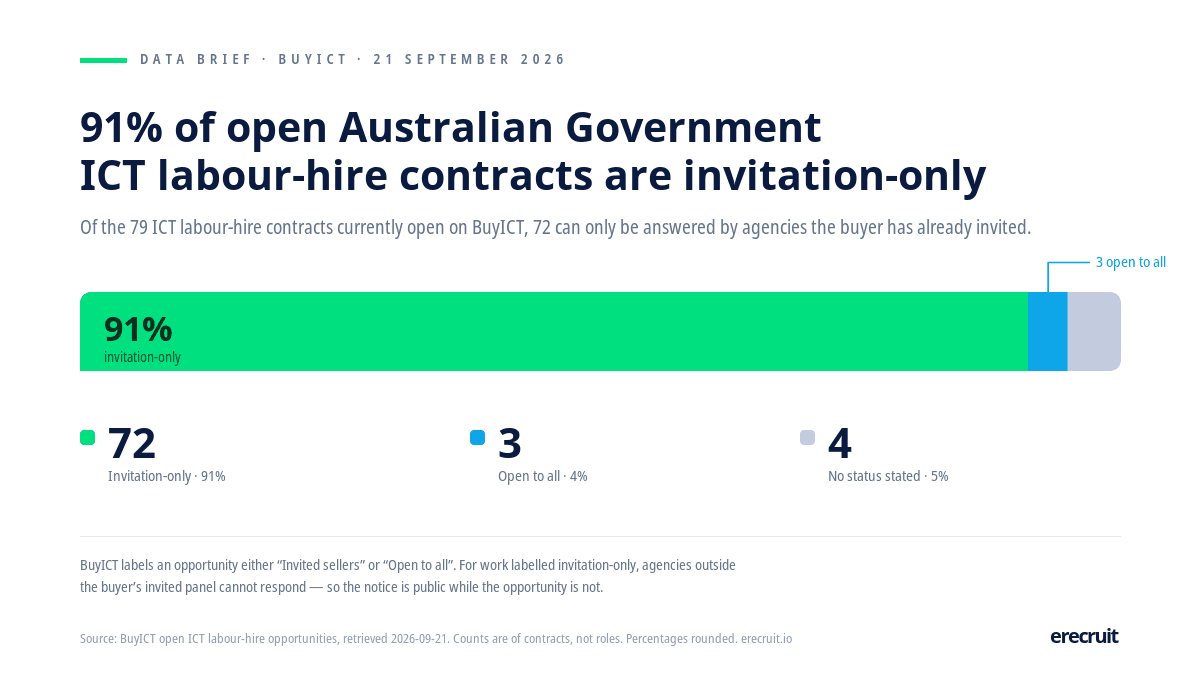
The short version
Of the 68 contracts open on BuyICT's ICT Labour Hire marketplace on 21 September 2026, 61 were invitation-only — 90%. Three were open to all. Four stated nothing either way.
That is the whole finding. The notices are public; the opportunity usually is not. For an agency that is not already on the relevant panel, nine tenths of the current market is work it cannot bid for, and there is no public list of who can.
Every figure here is counts of contracts, not of roles, and moves as contracts open and close. The live count is at erecruit.io/press.
What "invitation-only" means on BuyICT
BuyICT labels every labour hire opportunity with an invitation posture:
- Open to all — any eligible seller on the relevant arrangement can respond.
- Invited sellers — only sellers the buyer invited are able to respond. The notice is published; the opportunity is not.
The label is not a preference or a warning. It is a gate. If your agency is not on the buyer's invited list, there is no mechanism to respond, however well suited you are — and you will only discover that by finding the invitation field, which sits alongside the headcount, the location and the close date rather than leading the listing.
How BuyICT labour hire opportunities actually work covers the portal's structure in more detail.
How the figure was counted
One read of BuyICT's ICT Labour Hire marketplace, filtered to opportunities open on 21 September 2026, with each row classified by the invitation field BuyICT publishes:
| Invitation status | Contracts | Share | | ---------------------- | --------: | ----: | | Invited sellers only | 61 | 90% | | Open to all | 3 | 4% | | No status stated | 4 | 6% | | Open, total | 68 | |
Three things about that table are worth stating plainly, because they bound what it proves:
- It is one BuyICT marketplace. BuyICT publishes across eight marketplaces; this counts only ICT Labour Hire. Professional & Consulting, Software & ERP, Cloud, Telecommunications, Data Centre, Hardware and Requests for Information are all excluded, as are AusTender and BuyNSW. Nothing here should be read as describing federal or state procurement generally.
- It counts contracts, not roles. A single contract can carry several seats, and BuyICT only states a headcount on some of them — 59 of the 68. Summing seats would give a smaller, softer number, not a bigger one.
- Four contracts state no invitation status. They are excluded from the 90% rather than assumed into it. If anything, the true share of gated work is higher, because an unstated posture cannot be assumed open.
Why the number is so high
Panel arrangements are the answer, and the mechanism is unremarkable. A buyer with work to place goes to the sellers it already has an arrangement with and invites them. That is what the arrangement is for.
What is not public is the size of the invited pool — how many agencies receive an invitation for a given buyer, and whether the same handful is invited every time. The notices are searchable; the invitation lists are not published anywhere. So the market's shape is visible in aggregate and invisible in each specific case, which is a difficult position to plan a bid from.
If you are an agency
The practical consequence is that invitation status should be the first field you read, not the last. Before you assess a role, check the posture:
- Open to all — the discriminating case. It is rare, so it is worth prioritising for exactly that reason.
- Invited sellers — only pursue it if you have a route in: an existing arrangement with that buyer, or a partner who holds one.
- Unstated — treat as unknown rather than open, and check the buyer's arrangements before spending time on it.
Chasing an invitation-only opportunity you were not invited to is unpaid work. That is the entire cost of reading this field last.
If you are a buyer
Nothing here suggests buyers are acting improperly. Inviting known sellers is the point of a panel, and it produces submissions from agencies whose compliance, insurance and rates are already established.
It does mean the same pool is drawn on repeatedly, and that the size of that pool is not visible from outside. If the intent is to broaden a supply base, the invitation field is the lever — and the notices alone will not show whether the base is actually widening.
What this does not say
- It does not say 90% of government ICT work is closed. It says 90% of the contracts open on BuyICT's ICT Labour Hire marketplace on one day were invitation-only.
- It does not say anything about the other seven BuyICT marketplaces, or about AusTender, BuyNSW, or state procurement.
- It is not a claim about the number of roles, which BuyICT does not consistently state.
- The figure moves, and this one has moved further than most. It read 84% early on 21 September and 81% a few hours later, on a set that still mixed in contracts from BuyICT's other marketplaces and the Western Australian state feed. Narrowing the dataset to ICT Labour Hire — the marketplace this product is actually about — took it to 90%. A correction that raises the number is unusual and worth checking: the working is at the live figure, which is the one to read.
Where to go next
- See the open opportunities — every live BuyICT ICT contract, with its invitation status, close date and the agency job ads matched to it.
- Government buyers — contracts grouped by the department or agency doing the hiring.
- Recruitment agencies — what each labour hire agency is advertising against.
- Which government contract is behind that job ad? — how an opportunity gets matched to the ad running behind it.
- The press page — the chart above, the current counts, and the method behind them.