

10 Candidate Sourcing Tools for Australian ICT
Compare 10 candidate sourcing tools for Australian Government ICT, with practical guidance on search, caching, outreach, workflows and eRecruit.
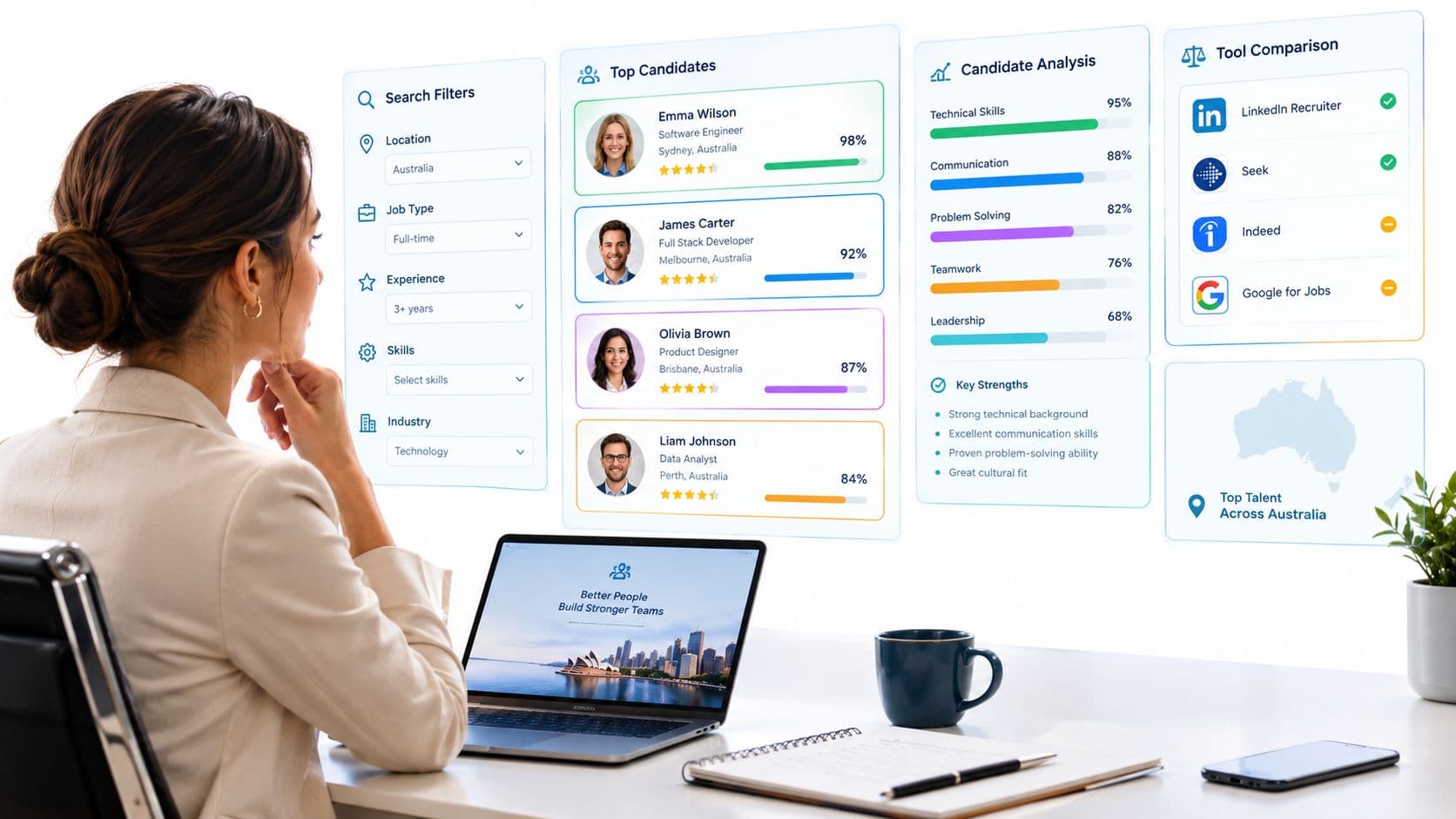
One database can't cover Australian Government ICT sourcing well. A local resume database may show candidates who actively maintain Australian profiles, while LinkedIn can reveal passive specialists. Technical-community tools may expose engineering evidence, but they won't tell you which panel supplier is recruiting against a live government labour-hire opportunity. An ATS can preserve pipeline history, yet it may not connect a candidate to the procurement context behind a public advertisement.
That distinction matters in Australia. Jobs and Skills Australia assessed 21% of ICT professional occupations as being in shortage, compared with 19% of all occupations, and found particularly high shortages among Business and Systems Analysts and Programmers. The same assessment recorded strong future demand across most ICT professional occupations. Jobs and Skills Australia's ICT Professionals assessment shows why generic keyword matching isn't enough.
This list evaluates candidate sourcing tools by the search they support, implementation effort, limitations and usefulness for a reusable workspace cache. The focus is Australian Government ICT jobs, cleared technical talent, BuyICT-linked opportunities and compliant movement from discovery to submission.
The popular advice is to choose the tool with the largest database. For technology recruiters, contractors, agencies and organisations working with Australian Government roles, the better question is different: does the tool help you find the right person, preserve the evidence and connect that person to a real opportunity? Recruiters comparing broader automation approaches can also review this guide to AI lead generation for recruiters.
Table of Contents
- 1. erecruit
- 2. LinkedIn Recruiter
- 3. SEEK Talent Search
- 4. Indeed Smart Sourcing
- 5. LiveHire
- 6. JobAdder with SEEK Talent Search Connect
- 7. hireEZ
- 8. AmazingHiring
- 9. ContactOut
- 10. Loxo Source
- Top 10 Candidate Sourcing Tools Comparison
- Build a Cache, Not Just a Contact List
1. erecruit
erecruit is the most specialised option in this list because it starts with the Australian Government ICT opportunity rather than with a generic candidate database. It maps open BuyICT ICT labour-hire opportunities to live advertisements run by tender-panel agencies, giving recruiters a way to investigate the contract context behind a role instead of guessing from a job title.
Best fit for opportunity-led sourcing
The platform connects role requirements with evidence fields such as skills, clearance, location and timing. Recruiters can then import candidates from external sources, retain profiles in a workspace cache and score CVs against a role with visible reasons and confidence scores. That workflow is materially different from saving a LinkedIn profile or downloading a resume.
Security clearance is a practical differentiator in government ICT. A Baseline clearance permits access up to and including PROTECTED, NV1 permits access up to SECRET, and NV2 permits access up to TOP SECRET, according to AGSVA's security clearance applicant guide. A sourcing workflow that stores clearance context alongside technical evidence is therefore more useful than one that treats clearance as an unstructured keyword.
The platform also includes a candidate pipeline, needs-review views, recruiter dashboards, email digests and in-app alerts. Continuous re-scoring is designed to surface a stronger match when an opportunity or advertisement changes. Direct links lead to panel suppliers' career pages and LinkedIn, rather than relying on Seek scraping.
Practical rule: Treat clearance, location, recent project evidence and candidate consent as separate fields. A profile that mentions “cybersecurity” isn't automatically suitable for a cleared government security role.
Strengths and trade-offs
Strengths
- Contract-to-ad context: Evidence-backed links clarify which opportunity, supplier, role and requirements sit behind an advertisement.
- Transparent matching: CV scores include reasons, allowing a recruiter to challenge or confirm the recommendation.
- Reusable cache: Imported candidates remain searchable for later opportunities instead of disappearing into an individual recruiter's browser history.
- Compliance workflow: A consent gate records representation approval before submission.
- Team readiness: Agency plans support multi-user workflows, API access for CRM and reporting, and shared pipeline visibility.
Limitations
- Narrow market focus: erecruit is built for Australian Government ICT and isn't intended for general commercial recruitment.
- Paid access after trial: The service offers a 7-day free trial with a card required, after which paid tiers apply.
- Not a replacement for every source: Recruiters may still need LinkedIn, SEEK, technical communities or an existing ATS to fill coverage gaps.
The tool is best for panel suppliers, agency teams and specialist recruiters that need live opportunity intelligence, candidate caching and defensible submissions. It is less suitable for an organisation seeking a general-purpose global talent database.
2. LinkedIn Recruiter
LinkedIn Recruiter is not a complete Australian Government ICT sourcing system. It is a discovery and outreach layer that can identify technical and cleared-talent prospects, but recruiters must add procurement evidence, permission records and opportunity context elsewhere.
Discovery and outreach
Its main advantage is network context. Recruiters can search for software engineers, cloud specialists, technical architects, DevOps practitioners and programme professionals while reviewing career history, activity and shared professional signals in one workspace.
Advanced filters, AI-assisted search, Recruiter Projects, pipeline management, bulk personalised InMail and mobile access support searches where the right candidate may not be applying. The workflow can move from profile discovery to direct contact without exporting every record.
LinkedIn works well for an initial longlist covering Azure, .NET, C#, Java, Python, Kubernetes, React, data engineering or cybersecurity. Profiles can also reveal experience with government agencies or panel suppliers. Those indicators require verification. A public profile shows a claimed background, not current clearance, recent production experience or consent to representation.
Australian Government ICT recruitment also needs location-aware search. Government digital workforce reporting identifies 7,876 current ICT and digital employees, with 58.3% located in the ACT, while 87% of APS ICT and digital vacancies include the ACT as a location. The Australian Government digital workforce current-state profile supports treating Canberra location and relocation constraints as search criteria rather than afterthoughts.
LinkedIn can find the person. It cannot, by itself, prove availability, clearance, consent or connection to the correct procurement opportunity.
Strengths and trade-offs
Strengths
- Passive talent reach: Direct outreach can reach people who are not responding to job-board advertising.
- Technical search: Filters and profile context support specialised ICT searches.
- Shared workspace: Recruiter Projects and pipeline tools help teams preserve promising profiles for later roles.
- Outreach continuity: Recruiters can review a profile and send InMail within the same operating environment.
- Familiar workflow: Many recruiters already understand LinkedIn search, projects and messaging.
Limitations
- Procurement context is absent: Recruiters must separately identify the BuyICT opportunity, panel supplier and submission requirements.
- Evidence can be incomplete: Profiles may omit clearance level, currency, consent status, availability or measurable project outcomes.
- Cache quality depends on process: Saved profiles are useful only when teams record source, review date, clearance evidence and contact permission in an ATS or shared workspace.
- Pricing is bespoke: Full Recruiter access is generally sold through a sales-led arrangement, while Recruiter Lite provides a more limited alternative.
Teams using LinkedIn as a primary source should preserve important profiles, verify claims before submission and connect each candidate to a live opportunity. Automation may assist this workflow, as outlined in AI recruitment software, while Digital Footprint Check's LinkedIn search guide offers another reference for platform-specific discovery.
3. SEEK Talent Search
SEEK Talent Search is the most locally oriented resume-database option in this comparison. It suits recruiters looking for Australian candidates who maintain SEEK profiles and may be open to approaches for ICT contractor jobs, APS ICT jobs or government technology roles.
Strong local coverage, narrower workflow
The product includes approachability and likely-interest signals, helping recruiters decide who may be receptive to contact. Its tiered structure includes Basic, Candidate Matches and Premium Talent Search, with features and contact allocations varying by plan. SEEK also supports direct profile and CV import into JobAdder through Talent Search Connect.
That local emphasis can complement LinkedIn. A recruiter searching for an Australian Azure engineer, C# developer or government DevOps contractor may find a different candidate set on SEEK from the one surfaced through professional networking search. The value isn't database size. It is the chance to reach people who regularly engage with an Australian employment platform.
SEEK doesn't solve the government-specific evidence problem. A profile may indicate technical capability but not whether a candidate has Baseline, NV1 or NV2 clearance, whether their clearance is current, or whether they consent to submission for a particular panel-supplier role.
Strengths
- Australian orientation: Useful for local ICT candidate discovery and contractor searches.
- Approachability signals: Helps prioritise outreach rather than treating every profile equally.
- JobAdder connection: Talent Search Connect can reduce manual transfer for teams using JobAdder.
Limitations
- Tier variation: Search depth, credits and contact features depend on the selected product level.
- Account dependency: Full product details and pricing require an employer account.
- Limited opportunity intelligence: Recruiters still need a separate process for matching a profile to a live government contract.
SEEK works best as a coverage source. Import useful candidates into a searchable workspace, add clearance and location fields, and retain the evidence that made the person relevant. Don't let a local database become another isolated list.
4. Indeed Smart Sourcing
Indeed Smart Sourcing is a subscription-based resume search service for broad candidate discovery and outreach. It gives Australian Government ICT recruiters another search surface when SEEK or LinkedIn does not produce enough relevant profiles, particularly for software development, systems administration, project delivery and technical support roles.
The practical value depends on how the team uses the results. Search for Python developers, application support specialists or other technical profiles, then record the evidence behind each match in a reusable workspace cache. A keyword shows possible relevance, not delivery experience. Clearance level, clearance currency, recent project context, location, flexibility and permission to represent the candidate still require separate checks.
The workforce problem is broader than technology titles. The Australian Government reports that 71% of agencies identified critical digital and ICT skill shortages, while 80% identified Individual Flexibility Arrangements as a key method for addressing those shortages in the Australian Government digital workforce profile. That supports capturing working preferences and location alongside technical evidence. It does not make Indeed a source of clearance verification or live contract intelligence.
Strengths
- Broad resume discovery: Adds coverage when searches on SEEK or LinkedIn are incomplete.
- Team coordination: Some plans provide contact pooling and sharing, which can help preserve a common candidate cache.
- Straightforward use: Recruiters can search resumes and build outreach lists without adopting a specialist technical-community workflow.
- Flexible search scope: Broad searches can surface adjacent technical profiles for later assessment.
Limitations
- Plan variability: Subscription features, contact access and pricing vary by market and may change.
- Less government context: Indeed does not directly connect a candidate to BuyICT contracts or panel-supplier advertisements.
- Verification burden: Recruiters must check clearance, project evidence, availability and representation permission before submission.
- Opportunity gap: A search result does not identify which live government role fits the candidate.
Indeed Smart Sourcing suits supplementary discovery. It becomes useful in a compliant pipeline only after recruiters preserve source evidence, confirm candidate consent and connect qualified profiles to current opportunities.
5. LiveHire
LiveHire is built for repeated engagement rather than a single resume search. Its private Talent Communities, direct communication tools and Live Market access make it useful when an Australian Government ICT supplier needs to maintain a reusable workspace cache of potential candidates.
Best fit: relationship-led government ICT sourcing
Recruiters can invite candidates into private communities, search those communities alongside the public Live Market, and communicate by SMS or email. The platform also provides analytics on community hires and external source performance. That combination supports recurring searches for cloud engineers, application developers, cybersecurity specialists, data professionals and delivery leads.
The cache has practical value only when recruiters maintain it. A candidate record should retain role fit, technology evidence, location, clearance status, consent history and the date of the last meaningful confirmation. Without those fields, re-engagement creates another verification task rather than shortening the path to a compliant submission.
Proactive pipelining is LiveHire's clearest contribution. Recruiters can build relationships before a requisition is approved, then revisit suitable candidates when a relevant government opportunity appears. Private community control separates an organisation's own pool from broader market discovery, while Re-engagement supports follow-up with candidates who were unsuitable or unavailable at an earlier point.
Its Analytics can help teams compare which communities and external sources generate useful engagement. That informs channel decisions, although it does not replace checking candidate evidence or confirming current availability.
The trade-offs affect operating discipline:
- Requires disciplined maintenance: Profiles, clearance information, availability and consent need regular review.
- Quote-based pricing: Commercial details generally require a conversation with the vendor.
- Not procurement intelligence: LiveHire does not independently show which BuyICT opportunity sits behind a panel-supplier advertisement.
LiveHire therefore works best as a relationship layer connected to a wider sourcing and compliance process. It preserves context between searches and can connect a known candidate to a live role, but it does not automatically map contracts to advertisements or score CVs against an active requirement.
6. JobAdder with SEEK Talent Search Connect
JobAdder is an Australian-born ATS and CRM that functions as a sourcing tool when connected to SEEK Talent Search Connect. Its value lies in the handoff from discovery to recruitment operations. A recruiter can import a SEEK profile, preserve the record in a reusable workspace cache, and attach the candidate to a role, client, stage and next action without repeatedly copying information between systems.
That workflow suits agencies managing several Australian Government ICT requisitions. Search results become working records rather than temporary browser tabs. Candidate history, ownership and follow-up tasks remain visible as requirements change.
The integration supports direct profile and CV import from SEEK, candidate management, pipelines and automation. It can connect a known person to a live opportunity, but it does not supply the opportunity context itself. Coverage depends on SEEK and other connected sources, so JobAdder is not an independent universe of technical or cleared talent.
Compliance still requires human checks. The ATS does not establish whether an advertisement relates to a particular BuyICT contract, whether a candidate has consented to representation, or whether clearance evidence remains current. The Digital Marketplace Panel 2 ICT Labour Hire arrangement describes the procurement mechanism through which approved sellers supply workers to government buyers. JobAdder can record the person and recruitment stage, while the recruiter verifies the contract, consent and evidence trail.
Its operating trade-offs are clear:
- Workflow continuity: SEEK profiles and CVs can move into the ATS with less manual re-entry.
- Pipeline control: Teams can assign ownership, stages, history and next actions.
- Source and plan dependency: Access to SEEK Talent Search Connect and relevant JobAdder features varies by subscription and connected sources.
- Compliance configuration: Consent, clearance evidence and contract linkage may require custom fields or integrations.
Teams comparing ATS capabilities can review this guide to software applicant tracking systems. JobAdder works best as the operational record. A separate opportunity source may still be needed to connect candidates with government demand.
7. hireEZ
A larger candidate database does not solve a difficult Australian Government ICT search. The main value of hireEZ, formerly Hiretual, is finding passive and specialised talent across the open web and social platforms when standard databases produce repetitive results. It is a top-of-funnel tool for technical searches, as detailed in this overview of sourcing software for recruiters.
hireEZ combines AI-assisted search with filters for diversity and work authorisation, a Chrome extension, contact discovery, Gmail assistance and Applicant Match. Applicant Match can bring older ATS records back into consideration, helping a team maintain a reusable workspace cache rather than starting each search from zero. Email, SMS and InMail sequencing then connect discovery with initial outreach.
For government ICT recruitment, that workflow is useful when capability is described differently across profiles. A person may have cloud delivery, platform engineering or data experience without matching the exact title in the brief. The recruiter still needs to verify what the evidence means. An “AI” keyword does not establish production machine-learning work, while “cloud” does not confirm secure government delivery or an appropriate clearance.
The APS Data, Digital and Cyber Workforce Plan describes continuing difficulty attracting experienced and mid-level digital and ICT workers and identifies data skills as a critical shortage area. Adjacent-skill discovery can widen the search, provided human review follows.
Its practical strengths are Passive technical discovery, ATS rediscovery, Outreach support and Browser workflow. These features help recruiters find less visible candidates, reuse internal records, reduce repetitive first-contact work and capture profiles during research.
The trade-offs are Data-quality risk, Quote-based pricing and No automatic procurement fit. Open-web records may be incomplete, duplicated or outdated. Commercial terms require vendor confirmation, and recruiters must still connect each candidate to the correct opportunity while checking capability, clearance and consent.
hireEZ should feed a controlled recruiting workspace and compliant pipeline. It should not replace evidence review or opportunity matching.
8. AmazingHiring
AmazingHiring is most useful when a government ICT search depends on visible technical evidence, not database size. It brings together profiles from GitHub, Stack Overflow, Kaggle, Dribbble and Behance, so recruiters can examine public engineering or creative work beside professional information.
A recruiter searching for software engineers, data specialists or designers can use repositories, contributions, rankings and community activity to test whether a claimed capability has supporting evidence. Searches across several networks, smart filters, a Chrome extension and an API make that evidence easier to collect and connect with internal systems.
The evidence remains partial. Java, Python, JavaScript, React or Kubernetes activity does not confirm security clearance, government delivery experience or current availability. A public profile also may not show whether someone will consider contract work in Canberra, another Australian location or a flexible arrangement.
The practical workflow is qualification first. Save relevant profiles to a controlled workspace cache, record the evidence and link each person to a live opportunity before outreach. Recruiters then verify recency, work context, clearance, consent and role fit before moving a candidate into the compliant pipeline.
Its value is clearest in four areas:
- Technical-community depth: Supports engineering and design searches where repositories or portfolios provide useful context.
- Cross-source profiles: Brings several public networks into one research process.
- Evidence-led discovery: Gives recruiters a stronger basis for the first conversation.
- Integration potential: The API can connect technical search with internal recruiting systems.
The limits affect procurement use. Role scope means the platform has greater value for teams that recruit technical roles regularly. Custom pricing requires a vendor quote. Incomplete community presence leaves capable government technologists outside the search. The Clearance gap remains material, because public technical activity cannot verify government security-clearance status.
AmazingHiring should supplement local databases and LinkedIn. It can identify technical signals and support a reusable cache, while recruiters retain responsibility for evidence review, opportunity matching and compliant candidate handling.
9. ContactOut
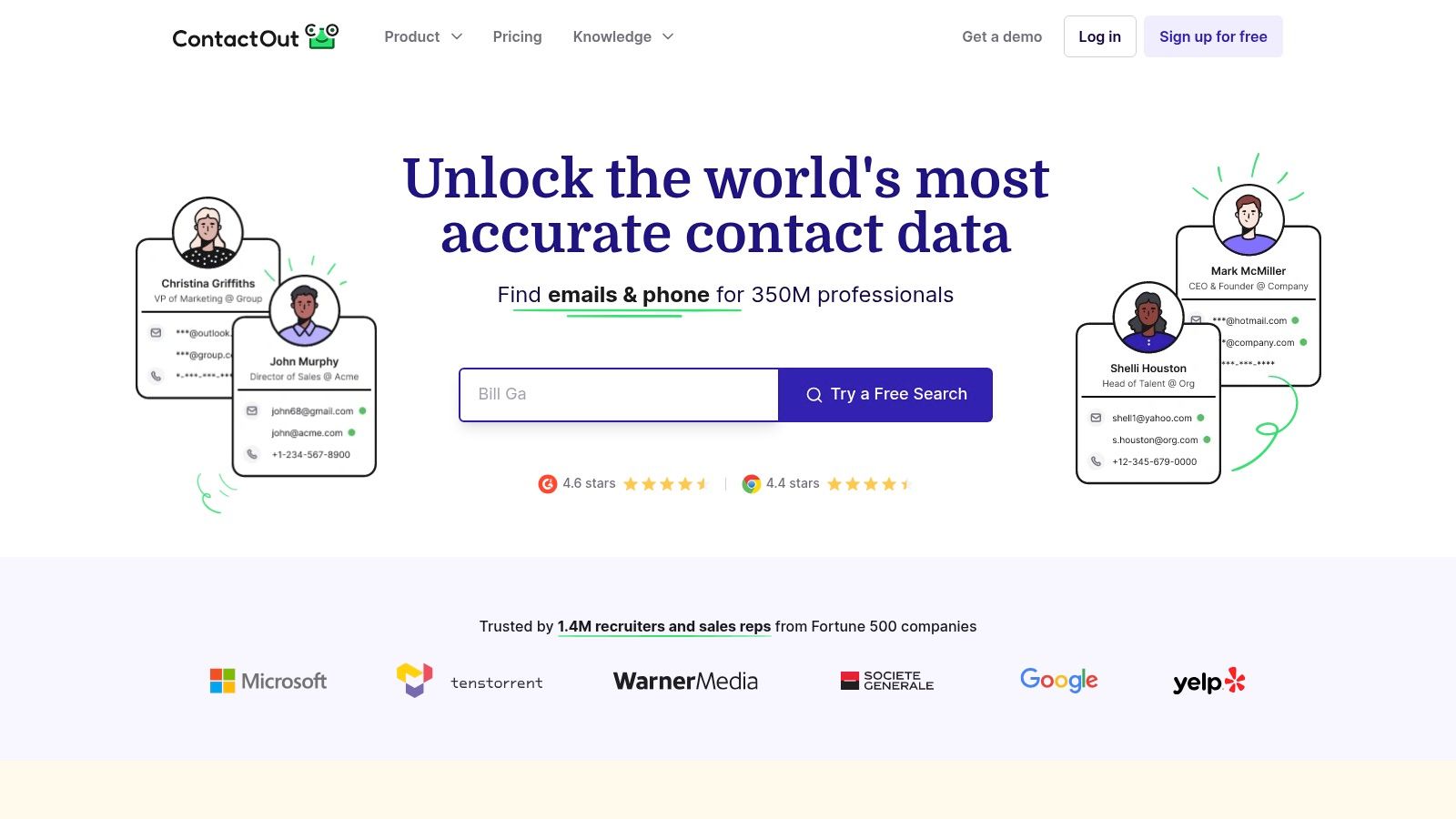
ContactOut does not solve candidate sourcing on its own. It solves a narrower problem: turning an identified LinkedIn profile into a reachable contact record.
The tool is LinkedIn-first. Its Chrome extension displays contact information beside supported profiles, while bulk enrichment can process profile URLs and connect with ATS or CRM systems. Basic sequencing and campaign features support initial outreach.
That workflow suits a recruiter who has already found a plausible Azure architect, software engineer, cybersecurity specialist or technical programme lead. The ContactOut record can then be linked to a live Australian Government ICT opportunity and retained in a reusable cache.
The tool does not establish whether the candidate fits the contract. Recruiters still need to check location, clearance, employment history, technical evidence, availability and consent. Contact details also require validation before outreach. A reachable person is not automatically a suitable or willing candidate.
What it adds to the workflow
Fast contact discovery reduces manual searching for an email address or phone number. Bulk enrichment is useful when a recruiter has already built a targeted list. Integrations can transfer records into an existing ATS or CRM, helping move a prospect into a controlled pipeline rather than leaving the research in separate browser tabs.
Where procurement teams should be cautious
ContactOut is not a candidate database. It enriches profiles discovered elsewhere, so it should supplement local databases, LinkedIn and other sourcing channels. Variable accuracy makes verification necessary, particularly for specialised technical communities.
Commercial uncertainty remains because self-serve pricing details and feature limits are not fully published. Teams should confirm current terms, permission requirements, data handling and source conditions before storing contact details. The product can shorten the route from profile to conversation, but it cannot verify government security clearance or replace compliant candidate assessment.
10. Loxo Source
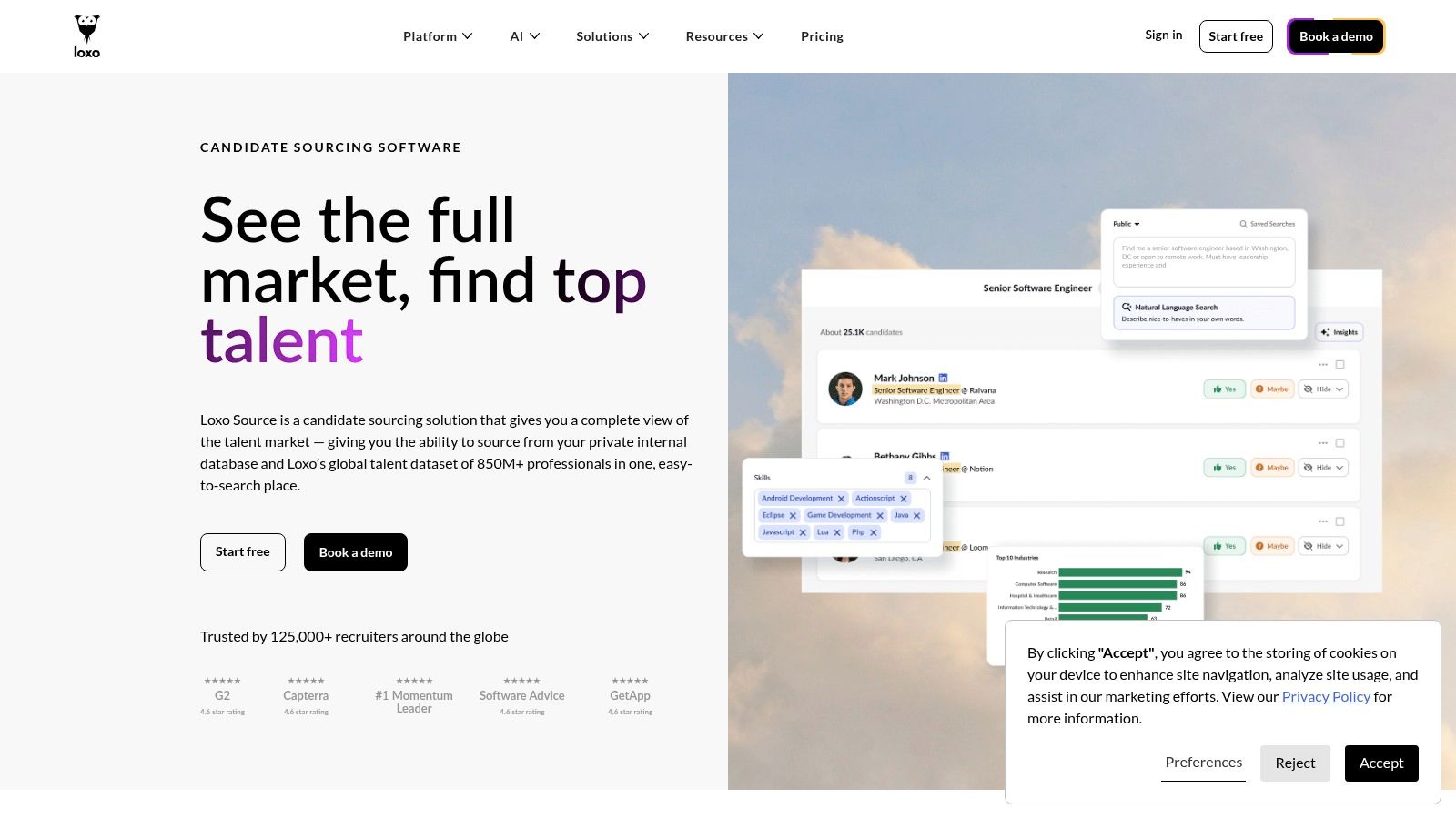
Loxo Source is most useful when an agency's existing candidate records are worth searching again. It combines a private database with Loxo's wider talent graph, AI matching, enrichment and outreach features. That makes it a consolidation option for small agencies, provided the internal records contain current evidence rather than archived resumes.
A searchable workspace cache
Loxo supports unified search across an ATS and its own dataset. Depending on the plan, teams can also use contact discovery credits and outreach automation. Its sourcing guidance covers workflows and agents, which may reduce the number of separate systems an agency operates.
For Australian Government ICT recruitment, the private database carries more practical value than the size of the external graph. A well-maintained record can preserve technology experience, location, clearance, availability and consent for later searches. A record containing only an old CV makes stale information easier to retrieve, not easier to assess.
The same qualification applies to external profiles. A broad talent graph does not establish that someone is in Australia, holds the required clearance, understands government delivery or wants a particular contract. Recruiters still need to verify those conditions before progressing a candidate.
Where Loxo fits
- Unified workflow: Search, enrichment, outreach and pipeline management operate in one platform.
- Internal rediscovery: Private records can be searched alongside external talent, supporting a reusable agency cache.
- Agency suitability: Consolidation may reduce tool sprawl for smaller teams.
- Automation: Plan-dependent outreach features can support repeatable engagement.
Decision factors
Public pricing can be inconsistent, so teams should confirm current terms. Sourcing credits and advanced capabilities may require higher-tier plans. The platform also lacks a direct connection between candidates and BuyICT opportunities, limiting its value for live contract-to-ad matching.
Data quality remains the main constraint. Loxo can surface prior records, but it cannot repair missing clearance evidence, outdated availability or weak consent controls. Teams should treat those fields as pipeline requirements.
Loxo Source suits agencies seeking a combined sourcing and recruiting workspace. For Australian Government ICT work, it is less specialised than erecruit for opportunity intelligence, contract-to-ad linkage and consent-gated submissions. See the Loxo Source product view.
Top 10 Candidate Sourcing Tools Comparison
- Product — Core features — UX & quality — Value & pricing — Target audience — Unique selling points
- 🏆 erecruit — Live BuyICT→ad linking; automated CV scoring; kanban pipeline; consent gate; API — ★★★★★ Recruiter KPIs, continuous re-scoring, alerts — 💰 Transparent tiers; 7‑day trial; Agency plan w/ API — 👥 Australian Govt ICT recruiters & agencies — ✨ Evidence-backed contract→ad mapping; consent-first workflow
- LinkedIn Recruiter — AI-assisted search, 40+ filters; InMail; Projects & pipelines — ★★★★★ Unmatched reach; strong sourcing signals — 💰 Bespoke / typically high (Lite = lower-cost) — 👥 Enterprise sourcers, agencies, passive talent hunters — ✨ Massive 1B+ network + integrated outreach
- SEEK Talent Search (AU) — AU candidate DB; approachability signals; JobAdder connect — ★★★★☆ Fresh local CVs for AU market — 💰 Tiered plans (Basic → Premium); employer account needed — 👥 Australian recruiters & agencies — ✨ Best localized AU coverage; JobAdder integration
- Indeed Smart Sourcing — Unlimited resume search (subs); contact pools; employer hub — ★★★★ Large database; easy resume discovery — 💰 Subscription-based; market-dependent pricing — 👥 High-volume recruiters & teams — ✨ Straightforward unlimited searches; team contact pooling
- LiveHire — Branded talent communities; Live Market; analytics & invites — ★★★★ Strong community engagement & analytics — 💰 Quote-based, typically annual — 👥 Employers building ongoing talent pools — ✨ Proactive pipelining & re-engagement focus
- JobAdder (w/ SEEK Connect) — ATS/CRM + embedded SEEK import; pipelines & automation — ★★★★ Minimizes tab-hopping; familiar AU workflows — 💰 Tiered pricing; SEEK entitlements required — 👥 AU agency teams using ATS-centric workflows — ✨ In-platform sourcing → ATS flow reduces admin
- hireEZ (Hiretual) — AI sourcing (20+ filters); Chrome extension; sequencing — ★★★★ Excellent passive/technical sourcing — 💰 Quote-based; variable by plan — 👥 Tech sourcers & TA teams — ✨ Multi-source aggregation + ATS re-discovery
- AmazingHiring — Multi-network tech indexing (GitHub, Kaggle etc.); extension — ★★★★ Superior for niche engineering/design roles — 💰 Quote-based / custom — 👥 Teams hiring engineers & designers regularly — ✨ Code/activity signals to qualify tech talent
- ContactOut — Chrome overlay for emails/phones; bulk enrichment; API — ★★★ Contact-finding speed; accuracy varies by niche — 💰 Self-serve pricing; some details via vendor — 👥 Recruiters needing fast contact discovery — ✨ Lightweight LinkedIn overlay for quick contacts
- Loxo Source (Loxo) — Unified search across ATS + global talent graph; outreach — ★★★★ All-in-one flow for small agencies — 💰 Pricing varies; credits/features gated by tier — 👥 Small agencies seeking unified sourcing + CRM — ✨ Large proprietary talent graph + AI-ranked matches
Build a Cache, Not Just a Contact List
The right candidate sourcing tools should create institutional memory. A recruiter who finds a cleared cloud engineer today should be able to locate that person for a relevant government opportunity later, with a clear record of technical evidence, location, availability, clearance context and representation permission.
Start by defining the market. List the Australian Government ICT roles and technologies your team targets, such as government software developer jobs, Azure roles, C# and .NET delivery, Java engineering, Python and data work, DevOps, Kubernetes, cybersecurity, cloud architecture, Power Platform, Microsoft 365, technical architecture or ICT programme management. Add the locations and work arrangements that matter. This prevents a sourcing platform from producing a large but strategically irrelevant pool.
Then choose the source that fills the coverage gap. LinkedIn is useful for passive professionals and career context. SEEK can add Australian resume coverage. AmazingHiring can provide public technical evidence. hireEZ can expand outbound discovery and rediscover ATS records. LiveHire can support a long-term talent community. JobAdder and Loxo can provide operational control. ContactOut can help with contact enrichment after a recruiter has already identified a suitable person.
The next step is evidence capture. Don't save a candidate as a name and a phone number. Record the specific role fit, technologies, project context, location, work flexibility, clearance level or status, last verification date and consent history. Clearance preparation also differs by level. AGSVA applicant information states that Baseline applicants provide address, employment and education information for the previous five years, while NV1 and NV2 applicants provide the previous ten years and at least one previous employment record. That difference matters when advising candidates and assessing readiness.
A reusable workspace should also support review. Profiles become stale, requirements change and a candidate who suited one role may not suit another. Before re-engagement, confirm that the candidate's contact details, technical evidence, availability, clearance context and consent remain current. AI matching should surface possibilities, not remove the recruiter's responsibility to inspect the evidence.
The best shortlist is not the one with the highest match score. It's the one a recruiter can explain to a candidate, a client and an internal reviewer.
For teams working specifically with Australian Government ICT labour hire, erecruit is the specialist layer in this stack. It links candidate searches to live BuyICT opportunities, connects contract records with panel-supplier advertisements, scores CVs against role evidence, retains imported candidates in a workspace cache and tracks candidates through a consent-aware pipeline. Its alerts and continuous re-scoring are designed for a market where the underlying opportunity and advertisement can change.
The broader market also shows why auditability matters. A July 2025 survey of 500 Australian hiring managers found that 49% used AI for candidate sourcing and 54% used it for resume screening, according to Robert Half's Australian AI and automation survey. A separate AHRI 2025 Australian Work Outlook report found that only 17% of employers currently use AI for candidate screening or shortlisting. The gap supports a cautious operating model: use automation to prioritise and explain, while keeping human review, original CVs, consent records and override decisions visible.
Validate current pricing, source permissions, integrations and government requirements before purchase or publication. Product features change, clearance rules can be updated and procurement arrangements have their own conditions. A tool earns its place when it improves the entire path from opportunity discovery to compliant submission, not merely when it returns more names.
erecruit maps Australian Government ICT procurement opportunities to live panel-supplier job advertisements, then helps recruiters score CVs, cache candidates, manage pipelines and record consent before submission. Visit erecruit to explore a specialist workflow for finding cleared technical talent and connecting candidates with real government ICT opportunities.