

Best Recruitment Software for Australian ICT Teams
Compare the best recruitment software for Australian Government ICT hiring, contracting and agency workflows, with pricing, strengths and trade-offs.
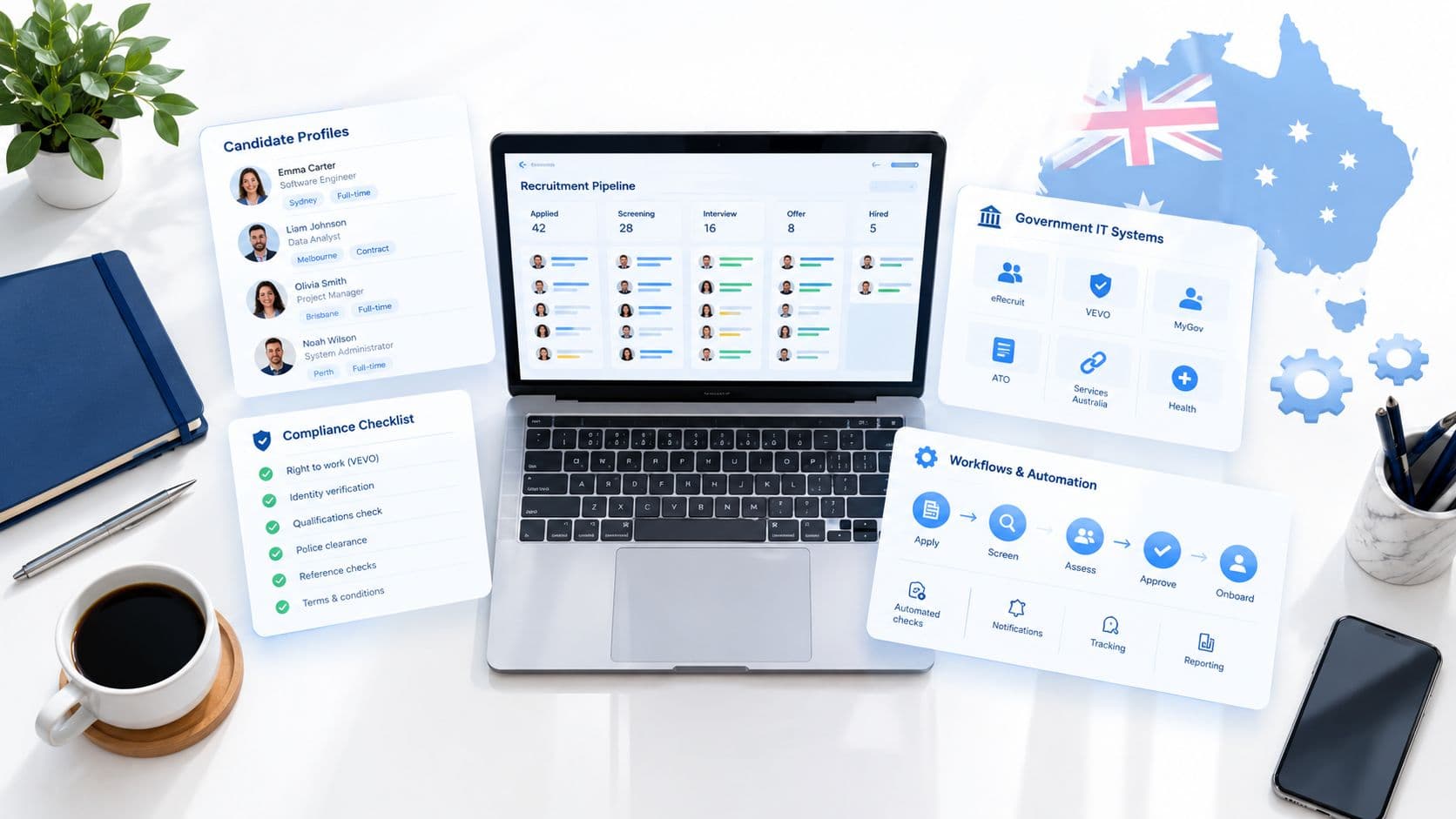
The most popular advice about the best recruitment software is usually wrong for Australian Government ICT. A general-purpose ATS may organise candidates effectively, but it won't necessarily show which BuyICT labour-hire opportunity sits behind a public job ad, whether a role depends on a particular clearance, or which panel supplier is recruiting.
That distinction defines this comparison. The relevant criteria are government opportunity discovery, contract-to-ad linkage, clearance-aware workflows, candidate matching, consent, pipeline control, integrations, implementation burden and pricing transparency. Government processes and software terms can change, so buyers should verify current requirements and commercial conditions before committing. The MakeAutomation hiring tool comparison provides useful broader context, but Australian Government ICT needs a more specialised lens.
The seven platforms below are ranked by fit for distinct problems, not by feature count. eRecruit is the specialist benchmark for connecting BuyICT opportunities with live panel-agency advertisements. Bullhorn and JobAdder address agency ATS and CRM operations, PageUp supports enterprise workflows, LiveHire builds talent communities, Greenhouse structures hiring decisions, and Zoho Recruit offers configurable value for smaller teams.
Table of Contents
- 1. eRecruit
- 2. Bullhorn
- 3. JobAdder
- 4. PageUp
- 5. LiveHire
- 6. Greenhouse
- 7. Zoho Recruit
- Top 7 Recruitment Software Comparison
- Choose the Workflow Before You Choose the Platform
1. eRecruit
eRecruit fits a specific Australian Government ICT recruitment problem: finding the relevant opportunity, linking it to a current agency advertisement, and managing candidate representation before submission. That focus makes it a specialist benchmark for opportunity intelligence, rather than a general replacement for every ATS or CRM.
The platform covers Australian Government ICT jobs, contracts, tenders and procurement opportunities. Its distinctive workflow is contract-to-ad mapping. eRecruit links BuyICT labour-hire opportunities with live advertisements from tender-panel agencies and displays fields such as role, clearance, location and timing. Recruiters can then open the relevant agency career page or LinkedIn listing, instead of inferring which government contract sits behind a generic technology advertisement.
The workflow reflects how public-sector ICT recruitment is structured. The Australian Government Digital Transformation Agency describes the Digital Marketplace Panel 2 as an open platform connecting government buyers with digital and ICT sellers. Federal, state, territory and local government agencies can use its ICT Labour Hire arrangement through BuyICT. The BuyICT buyer guidance also directs eligible buyers to the APS Job Family Framework when identifying ICT Labour Hire roles.
Why the workflow is different
eRecruit re-scores candidate matches as opportunities and advertisements change. Recruiters can upload CVs, review confidence scores with stated matching reasons, and prioritise candidates in a kanban pipeline. A consent gate records approval for candidate representation before submission, which helps when several agencies may be pursuing similar government roles.
Candidate search and import, a workspace-level cache, recruiter dashboards, email digests, in-app alerts, and a feed of open and recently closed opportunities support the same process. The Agency plan includes API access for CRM and reporting integrations. Documentation and FAQ content support self-serve onboarding for individual recruiters and multi-user agencies.
Practical rule: A shortlist should show why the candidate matches the role and whether representation approval has been recorded.
At the time of writing, eRecruit's own dashboard reported 14 labour-hire agencies running 2,656 live ads, including Randstad with 1,252, Chandler Macleod with 409 and Talent International with 275, as shown on the eRecruit live opportunity feed. These are vendor-reported figures, not independent evidence of total market coverage. Buyers should validate current listings before relying on them.
eRecruit offers a 7-day free trial, with a card required and cancellation available at any time, plus transparent plans for individual recruiters and teams. Its trade-off is scope. It suits Australian Government ICT and BuyICT workflows, while broader recruitment CRM systems may better serve unrelated sectors or overseas public-sector markets. Teams requiring deeper CRM integration should also review this recruitment CRM systems guide.
2. Bullhorn
Bullhorn is the most natural choice in this list for an agency that needs a mature ATS and CRM operating system across contract, temporary and permanent recruitment. It combines candidate records, client relationships, email synchronisation, resume parsing, job posting and career-portal functions in one agency-focused environment.
That matters for panel suppliers managing more than one government opportunity at a time. Bullhorn can provide a central record of candidate conversations, job activity and placements, while automation and analytics add-ons support recruiter productivity and operational reporting. Its marketplace and partner ecosystem also give agencies routes to connect sourcing, communications and other specialist tools.
Best for agency delivery
The platform's advantage is breadth. A growing staffing organisation can use it as a system of record rather than building a process from spreadsheets, inboxes and disconnected job-board accounts. Its APAC presence and Australian small-agency editions make it more relevant to local buyers than a purely US-oriented agency CRM, while published Australian pricing for smaller agencies gives some buyers a clearer starting point than a fully opaque enterprise quote.
Bullhorn's weakness is the same breadth. Implementation, configuration and higher-tier capability can create a meaningful burden for smaller teams. A recruiter focused narrowly on Australian Government ICT opportunity intelligence may still need a specialist layer to discover the underlying contract and connect a BuyICT opportunity to a panel supplier's live advertisement.
Bullhorn can manage the agency relationship after a lead enters the pipeline. It doesn't automatically make a generic public job ad intelligible as a government procurement opportunity.
For an agency already running a complex staffing desk, Bullhorn is a credible broad foundation. For a specialist government ICT recruiter, it complements eRecruit rather than replacing it. The two tools solve different problems: eRecruit identifies and explains the opportunity, while Bullhorn can manage the wider agency workflow, client record and placement operation.
3. JobAdder
JobAdder earns consideration for a specific reason: it reduces adoption friction for Australian and New Zealand recruitment teams. Its ATS and CRM combine candidate management, resume parsing, pipeline tracking and job posting, with integrations such as SEEK and LinkedIn supporting channels used by local recruiters.
That makes JobAdder a practical option for small to mid-sized agencies that need an operational system without starting with a heavily configured enterprise deployment. Published platform documentation states that recruiters can post to more than 200 job boards, including key APAC connections, through a central workflow, according to JobAdder's job-board distribution documentation. This distribution can help a panel supplier respond quickly to a government software developer, cloud engineer or cybersecurity requirement.
Usability is the buying argument
JobAdder's strongest case is workflow clarity rather than maximum enterprise control. Candidate pipelines, job records and communications are organised around daily agency work. An API sandbox and add-ons such as Smart Forms and a Hiring Manager Portal extend that workflow for teams with specific process requirements.
Pricing is quote-based. Buyers should request a written breakdown covering users, integrations, reporting and add-ons before comparing it with alternatives. Some advanced analytics may require additional purchases, while power users may find the reporting layer less detailed than an enterprise platform.
The platform also leaves a gap in opportunity intelligence. It can help a panel agency advertise and manage candidates for an Australian Government ICT role, yet it does not necessarily establish which BuyICT opportunity sits behind the advertisement. eRecruit remains the specialist benchmark for connecting BuyICT opportunities with live panel-agency ads. JobAdder complements that process as the ATS and CRM used after the opportunity has been identified.
The clearest fit is an AU or NZ team seeking local sourcing connections, candidate stages and rapid recruiter adoption. If the priority is government job distribution, candidate stages and recruiter adoption, JobAdder deserves consideration. If the requirement is evidence that procurement activity connects to a live agency advertisement, the buying decision needs a separate discovery workflow rather than a broader feature count.
4. PageUp
PageUp is built for a different operating environment from eRecruit, Bullhorn and JobAdder. Its strongest fit is a large organisation that needs configurable talent acquisition workflows, compliance controls and connected modules across recruitment, onboarding, learning, performance and succession.
That makes PageUp relevant to government departments, public-sector bodies, healthcare organisations and large employers with formal approval paths. The platform's recruitment management features support configurable workflows and analytics, while broader native modules can reduce the need to join several separate talent systems together.
Enterprise control over specialist visibility
PageUp's public-sector relevance is an important advantage, but it shouldn't be confused with procurement opportunity intelligence. An internal talent team may use PageUp to manage applications for government software engineer jobs, APS ICT jobs or government cybersecurity jobs. An agency looking for the panel supplier's live advertisement behind a labour-hire requirement needs a different type of data connection.
The distinction is operational. PageUp is strongest after an organisation has defined its requisition, hiring process and governance model. eRecruit is strongest when a recruiter needs to discover an external opportunity, understand its evidence fields and identify the live agency ad connected to it.
PageUp is quote-based and typically requires enterprise-level implementation. That can be justified where the buyer needs configurable controls across a complex organisation, but it may be excessive for a small panel agency placing security-cleared contractors. Candidate-side experience has also received mixed feedback in online discussions, so a buyer should test the application journey with real users rather than relying on a feature list.
For large public-sector employers, PageUp is a serious enterprise candidate. For labour-hire agencies, it's more likely to complement an agency CRM and a specialist Australian Government ICT opportunity platform than to replace either one.
5. LiveHire
LiveHire takes a relationship-led approach. Its Talent Communities let employers and RPO teams build private, branded candidate pools, enrich profiles and continue two-way communication across requisitions.
That makes LiveHire a fit for recurring technology hiring, rather than for discovering the next government labour-hire opportunity. A department, consultancy or panel supplier recruiting Azure specialists, .NET developers, cloud architects, data engineers or security-cleared contractors can maintain relevant relationships instead of restarting each search.
A strong retention layer
LiveHire's documented value is continuity. Candidate communication, profile enrichment and pooled pipelines support proactive recruitment when related roles reopen. LiveHire's public materials list deployments with Australian healthcare providers and state government clients, while LiveHire's published customer references give buyers a starting point for checking current, comparable public-sector workloads.
The trade-off is workflow coverage. An agency serving multiple clients and managing mandates, placements and contracts may need integrations or a separate agency CRM. Commercial terms and tiers can change, so buyers should confirm current pricing, data handling, implementation requirements and integration coverage before selecting it.
A talent community also does not map BuyICT opportunities. It may contain a suitable government DevOps contractor, yet it does not by itself identify the open labour-hire request, clearance condition or panel-agency advertisement that should receive that candidate. That distinction places LiveHire downstream of opportunity intelligence.
A talent community preserves relationships. Opportunity intelligence identifies where to apply them today.
For a large employer or RPO building sustained Australian Government technology pipelines, LiveHire can complement a specialist opportunity workflow. eRecruit can identify live opportunities, while LiveHire maintains candidate engagement over time. Broader ATS or CRM tools may then handle requisitions, submissions or delivery records, but they do not automatically replace either system's specialised role. Buyers should test whether consent records, status changes and submission trails transfer cleanly between platforms. The sourcing software guide for recruiters offers context for designing that workflow.
6. Greenhouse
Greenhouse is the strongest choice here for structured hiring. Its interview kits, standardised scorecards and hiring workflows help organisations apply consistent evaluation criteria across technical and non-technical roles.
That makes it useful for technology companies, consultancies and internal talent teams hiring software developers, technical architects, project managers or data specialists. AI features support feedback summarisation, job-description assistance and scheduling, while a mature integration ecosystem connects Greenhouse to common recruiting and calendar tools.
Structure isn't the same as opportunity discovery
Greenhouse's value appears when an organisation has already defined the role and wants hiring managers to assess candidates consistently. Scorecards can make a panel interview more comparable, and standardised feedback can reduce the risk that one manager's informal preference dominates a technical hiring decision.
Its limitation for Australian Government ICT agencies is upstream. Greenhouse isn't primarily an opportunity-intelligence system, and agencies may need companion tools for client management, contract tracking, candidate consent and procurement-linked workflows. An agency using Greenhouse for government labour-hire could still need eRecruit to identify the relevant BuyICT opportunity and evidence the link to the live panel ad.
Pricing is quote-based and can sit toward the mid-to-upper range for smaller firms. Agencies that need deep sales, client and placement functions may also require a separate CRM. Those trade-offs don't undermine Greenhouse's structured-hiring strengths, but they do affect the total stack and implementation burden.
The platform is best for teams that want hiring managers to evaluate candidates against defined criteria rather than relying on unstructured impressions. For a government technology employer, it can support a disciplined selection process. For a panel recruiter, it's more likely to complement an opportunity and agency workflow than serve as the whole recruitment operation. The applicant tracking software guide can help teams assess where a structured ATS fits in a broader stack.
7. Zoho Recruit
Zoho Recruit is the value-oriented option for smaller agencies, boutique recruiters and internal teams that want a configurable ATS without starting with an enterprise implementation. Its Staffing Agency edition includes client and job-order management, resume formatting and candidate workflow functions.
The platform's wider Zoho ecosystem is a meaningful advantage. Teams already using Zoho CRM or other Zoho applications can create a connected operating environment, while integrations with Google Meet, Microsoft Teams, Slack, Mailchimp, assessments and other tools extend the recruitment workflow.
Flexible value with a configuration cost
Zoho Recruit also provides AI features through Zia for candidate matching and content, with an optional OpenAI connection described in the product information supplied for this comparison. Public, tiered subscription options and online Australian billing make it easier for an SMB to investigate commercial fit than a platform that only provides a sales quote.
That accessibility doesn't remove the need for careful testing. Deep customisation can require setup expertise, and some teams may outgrow the native analytics. The strongest CRM capabilities may appear when Zoho Recruit is paired with Zoho CRM, which increases the configuration and total-system decision.
For Australian Government ICT recruiters, the main limitation is specialisation. Zoho Recruit can organise candidates for Azure, Java, Python, cybersecurity or government project roles, but it doesn't on its own identify the BuyICT contract behind a public job advertisement. It can therefore work as a cost-conscious ATS layer alongside eRecruit, particularly for a small agency that needs candidate records, client orders and configurable forms.
The right buyer is an SMB that values fast configuration, broad integrations and transparent purchase options more than deep enterprise reporting. Before adopting it, confirm how the system will record clearance evidence, candidate consent, representation approval and the relationship between a government opportunity and the submitted role.
Top 7 Recruitment Software Comparison
- Product — Implementation complexity 🔄 — Resource requirements ⚡ — Expected outcomes 📊 & ⭐ — Ideal use cases 💡 — Key advantages ⭐
- erecruit — 🔄 Low–Medium (SaaS; fast onboarding; API on paid plans) — ⚡ Low–Medium (single recruiters to teams; trial requires card) — 📊 Highly targeted gov ICT matches; ⭐⭐⭐⭐ — 💡 Recruiters/agencies focused on Australian Government ICT (BuyICT) — ⭐ Evidence-backed contract↔ad mapping, continuous CV scoring, consent workflow
- Bullhorn — 🔄 Medium–High (configurable platform; marketplace integrations) — ⚡ Medium–High (license & implementation costs for larger tiers) — 📊 Scalable end-to-end agency workflows; ⭐⭐⭐⭐ — 💡 Staffing agencies needing full ATS/CRM and upgrade paths — ⭐ Built for staffing workflows, strong marketplace, APAC editions
- JobAdder — 🔄 Low (known for usability and fast onboarding) — ⚡ Low–Medium (cloud SaaS; add‑ons incur cost) — 📊 Fast recruiter onboarding and local sourcing; ⭐⭐⭐ — 💡 Small–mid AU/NZ agencies prioritising SEEK/LinkedIn sourcing — ⭐ Easy to learn, deep SEEK/LinkedIn connectivity, quick time‑to‑value
- PageUp — 🔄 High (enterprise configuration and workflows) — ⚡ High (enterprise pricing, long implementations) — 📊 Enterprise-grade talent suite and compliance; ⭐⭐⭐⭐ — 💡 Large organisations and compliance-heavy sectors (public, health, education) — ⭐ Configurable workflows, broad native modules, enterprise controls
- LiveHire — 🔄 Medium (community + ATS features; configurable) — ⚡ Medium (community management focus; commercial terms vary) — 📊 Strong ongoing engagement and pooled pipelines; ⭐⭐⭐ — 💡 Employers/RPOs building talent communities and repeat hiring — ⭐ Talent communities, two‑way messaging, RPO-friendly model
- Greenhouse — 🔄 Medium (structured hiring set-up; integrations) — ⚡ Medium–High (quote-based pricing; integration effort) — 📊 Consistent, data-driven hiring and evaluation; ⭐⭐⭐⭐ — 💡 Tech and services firms seeking structured interviews and analytics — ⭐ Structured hiring, interview kits/scorecards, mature ecosystem
- Zoho Recruit — 🔄 Low–Medium (configurable; familiar for Zoho users) — ⚡ Low (competitive SMB pricing; customization may add effort) — 📊 Cost-effective ATS for SMBs and agencies; ⭐⭐⭐ — 💡 SMBs and boutique agencies needing fast setup and Zoho integration — ⭐ Strong price-to-feature, Zoho stack integration, public tiered plans
Choose the Workflow Before You Choose the Platform
The best recruitment software for Australian ICT isn't the platform with the longest feature list. It's the system that removes the most consequential uncertainty from your workflow.
Choose eRecruit when your central problem is finding Australian Government ICT opportunities, connecting BuyICT labour-hire requests to live panel-agency advertisements, matching CVs with explainable evidence, tracking clearance-related information and recording candidate consent before submission. The Australian market has a specific timing problem. Jobs and Skills Australia's 2025–26 analysis recorded an IT industry recruitment rate of 32%, below the 41% average for other professional, scientific and technical services and the 49% all-industry average, while only 16% of IT employers expected to increase staffing in the next three months, below the all-industry average of 19%. The Jobs and Skills Australia IT recruitment analysis supports a practical conclusion: when hiring appetite is uneven, recruiters need better prioritisation of live opportunities rather than more undirected searching.
Choose Bullhorn or JobAdder when the main requirement is agency ATS and CRM delivery. Bullhorn is the broader choice for complex staffing operations, marketplace integrations and upgrade paths. JobAdder is the more approachable option for Australian and New Zealand teams that prioritise recruiter adoption, SEEK and LinkedIn connectivity and fast onboarding.
Choose PageUp for a large organisation that needs configurable public-sector or enterprise talent workflows. Choose LiveHire when the business case depends on private talent communities, two-way engagement and repeat hiring across related technology skills. Choose Greenhouse when structured interviews, scorecards and consistent hiring-manager evaluation are the priority. Choose Zoho Recruit when an SMB wants configurable agency functions, online purchasing and integration with a broader business application stack.
Buyers should validate the following before signing:
- Current commercial terms: Confirm user limits, add-ons, API access, implementation costs, trial conditions and renewal terms directly with the vendor.
- Australian requirements: Test how the platform handles candidate consent, representation approval, clearance evidence, retention rules and access controls. AGSVA defines Baseline access up to and including PROTECTED, NV1 up to and including SECRET, and NV2 up to and including TOP SECRET in its security clearance applicant guide. Those requirements should be checked against the organisation's actual roles and policies.
- Opportunity linkage: Ask whether the system can connect a live job advertisement to the government opportunity, panel supplier, role, location, timing and clearance requirement, rather than merely storing a job record.
- Integrations and migration: Confirm data export, API limits, CRM connections, job-board integrations, reporting feeds and the practical cost of moving existing candidate records.
- Workflow evidence: Test a real candidate from discovery through matching, consent, submission, interview and placement. A demo using generic data won't expose missing government-specific fields.
- Reporting and support: Verify that dashboards answer operational questions such as which opportunities need review, which candidates lack consent and which roles are approaching a response deadline.
The Australian applicant tracking market is already substantial and expanding. One market estimate places it at USD 62.49 million in 2025, projecting USD 122.21 million by 2034 at a 7.74% CAGR, with cloud deployment holding 68.4% share and software accounting for 71.6%, according to Australia applicant tracking system market research. Those figures explain why buyers have many options, but they don't identify the right workflow. A larger market creates more choice, not a universal winner.
Map the selected platform against your target agencies, technology disciplines, clearance levels, procurement channels and recruitment volume before committing. Start with the government ICT problem you need to solve, then decide which broader ATS, CRM, talent-community or structured-hiring tools should complement the specialist layer.
eRecruit maps Australian Government ICT procurement opportunities to the live job advertisements tender-panel agencies are running, then adds CV matching, confidence scoring, pipeline management and a consent-first submission workflow. Visit erecruit to see how the platform can help your team connect BuyICT opportunities with the candidates and agency ads that matter now.