

10 Recruitment CRM Systems for ICT Agencies
Compare 10 recruitment crm systems by workflow fit, features, limitations and buyer profile, including eRecruit for Australian Government ICT…
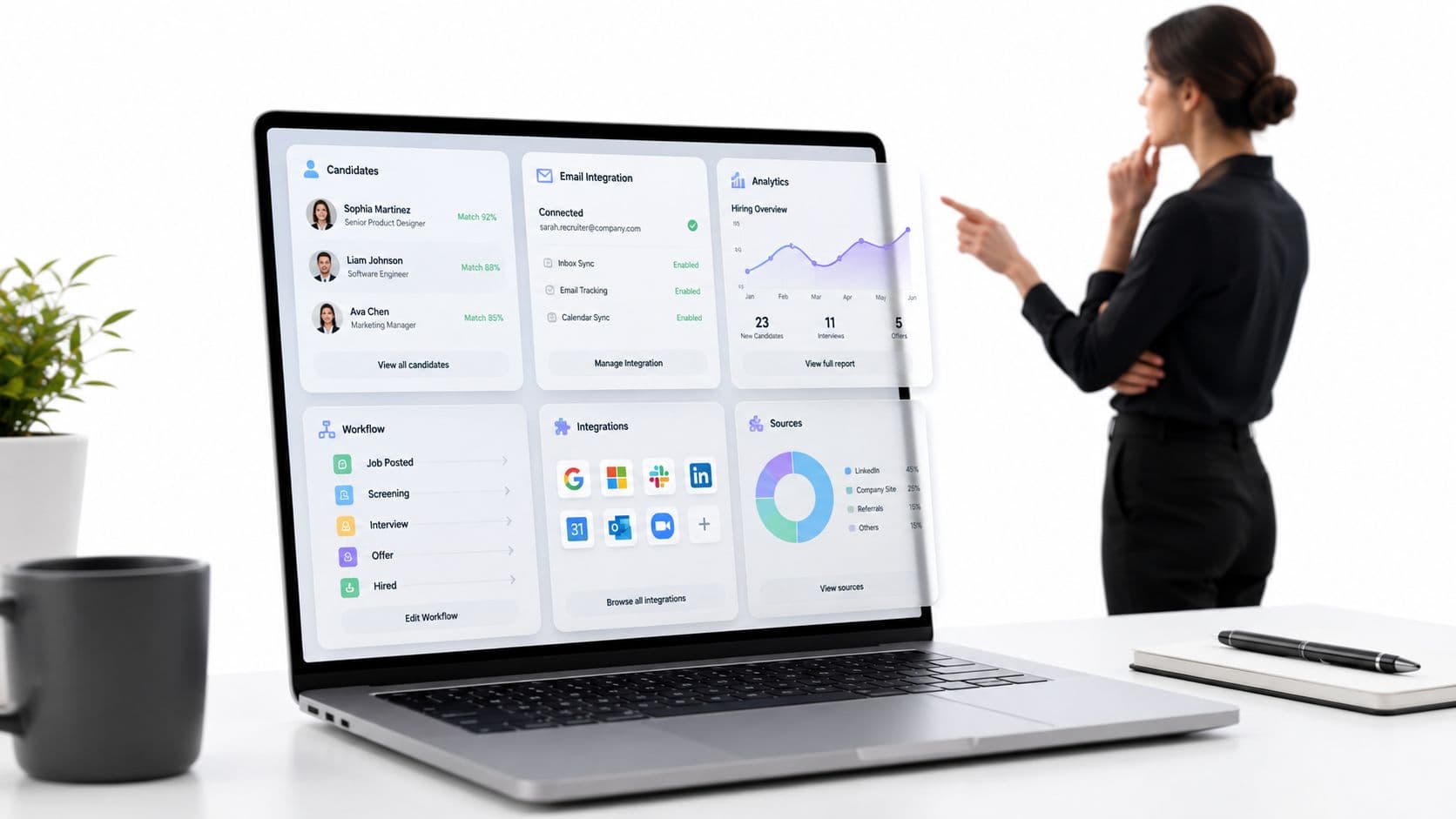
The most popular advice about recruitment CRM systems is also the least useful: choose the platform with the longest feature list. That approach fails because an agency doesn't buy features, it buys a daily operating model. A system that excels at outbound sourcing may be poor at government opportunity discovery, while an enterprise ATS and CRM may create unnecessary implementation work for a specialist ICT recruiter.
This comparison assesses ten recruitment CRM systems by the workflows that matter in practice, including discovery, sourcing, matching, pipeline control, compliance, reporting, implementation burden, pricing transparency and relevance to Australian Government ICT recruitment. The list includes broad ATS-plus-CRM products, alongside eRecruit, a specialist opportunity-intelligence and workflow platform built around Australian Government ICT contracting.
That distinction matters. A general recruitment CRM helps manage candidates, clients and jobs. eRecruit connects BuyICT opportunity intelligence with live labour-hire advertisements, then adds matching, evidence fields, consent and pipeline tools around that workflow. If your agency is trying to streamline talent acquisition, the right choice depends on where your process loses time.
Pricing, integrations, product names and capabilities can change. Verify current plans, data coverage, implementation terms and integration requirements with each vendor before buying.
Table of Contents
- 1. eRecruit
- 2. Bullhorn
- 3. JobAdder
- 4. Access Vincere
- 5. Recruit CRM
- 6. Loxo
- 7. Manatal
- 8. Zoho Recruit
- 9. Tracker
- 10. Crelate
- Top 10 Recruitment CRM Systems: Feature & Pricing Comparison
- Choose the System That Matches Your Operating Model
1. eRecruit
eRecruit is the specialist option in this comparison. It is built for Australian Government ICT employment, contracting, procurement and technology opportunities, rather than broad recruitment markets. Its distinctive workflow connects government contracting signals with live advertisements from tender-panel agencies.
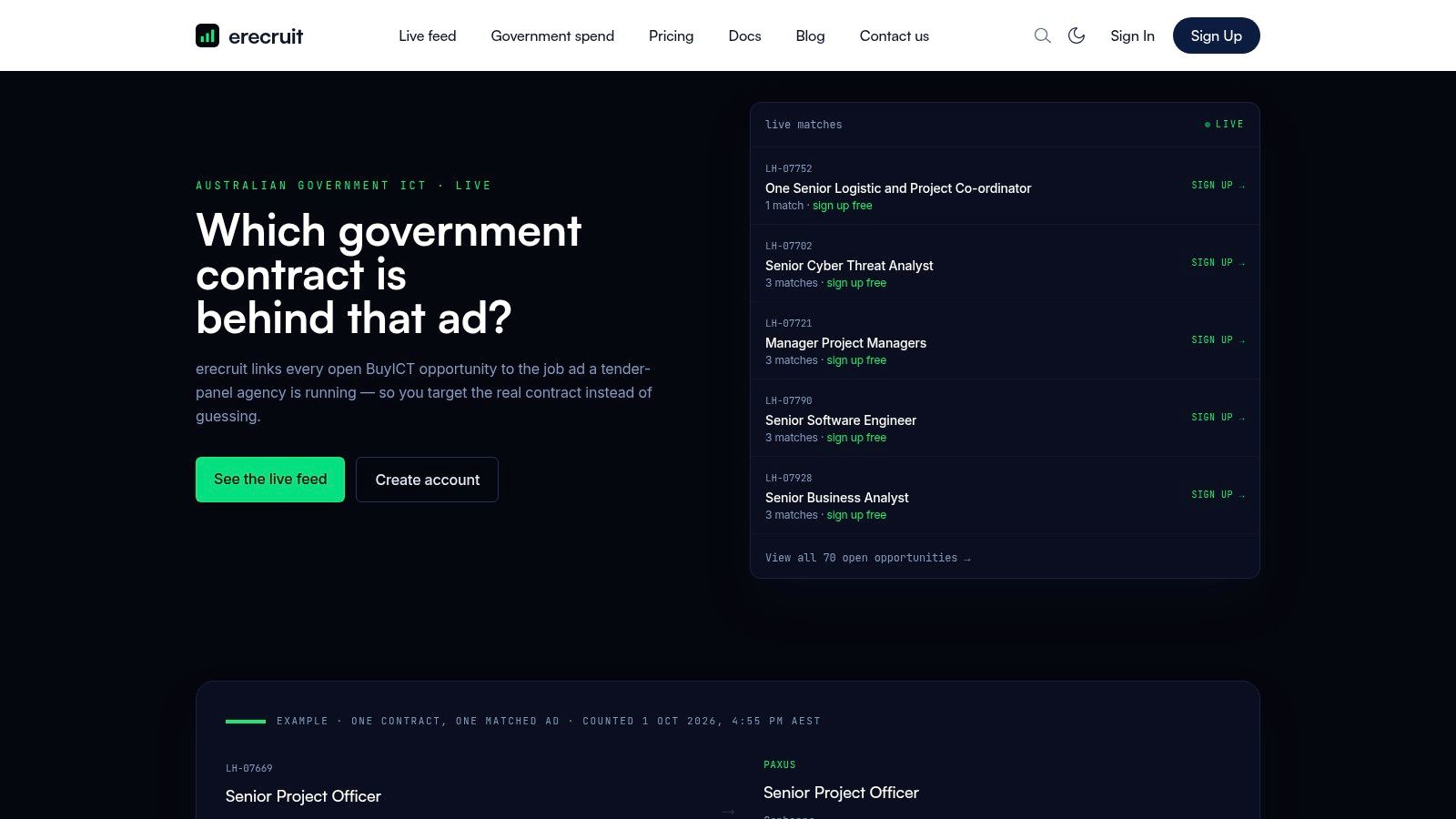
That connection changes the order of work. For example, a recruiter reviewing a BuyICT labour-hire request for an NV1-cleared Azure Engineer in Canberra can open the panel supplier's live advertisement, compare clearance and timing evidence, and decide whether to source before creating or advancing a CRM record. The recruiter can then follow a navigable link to the relevant panel agency career page or LinkedIn listing instead of reconciling procurement notices and job boards manually.
Where eRecruit changes the agency workflow
Automated CV matching adds a second decision layer after opportunity discovery. The platform provides transparent confidence scores and re-scores matches when an opportunity or advertisement changes. Email digests and in-app alerts help recruiters review relevant opportunities in priority order. This supports a focused Australian Government ICT workflow, although it does not replace a general-purpose recruitment database for unrelated markets.
Pipeline kanban, recruiter dashboard, needs-review and recent-activity views show what happened after discovery. The consent gate records candidate representation approval before submission. That record matters when an agency must demonstrate that a candidate agreed to representation for a specific role, rather than relying on an informal email or memory.
Practical rule: If a recruiter cannot identify the government opportunity behind an advertisement, the panel supplier involved and the status of representation consent, the submission process is not ready.
eRecruit fits individual ICT recruiters, panel-supplier teams and agency owners focused on Australian Government placements. It offers free sign-up and a seven-day trial, with a card required and cancellation available at any time. Simple pricing supports individuals and multi-user teams, while the Agency plan adds API access for CRM and reporting integration.
The trade-off is deliberate specialisation. Coverage focuses on Australian Government ICT BuyICT opportunities, and results depend on panel agencies publishing advertisements on linked sites. Agencies recruiting outside that market may need another system for broader job, client and candidate management.
Pros
- Contract-to-ad evidence: Links the opportunity behind an advertisement with role, clearance, location and timing details.
- Transparent matching: Scores CVs against roles and shows the confidence behind each match.
- Consent-first pipeline: Combines candidate tracking, stage management and representation approval.
- Focused alerts: Surfaces relevant opportunities and matches without repeated manual searching.
- Agency integration: The Agency plan provides API access for CRM and reporting workflows.
Cons
- Narrow market fit: It offers limited value for non-Australian or non-ICT recruitment.
- Account requirements: Some match details and advertisements require an account, and the trial requires a card.
- Coverage boundaries: It links to panel supplier career sites and LinkedIn rather than every job board.
Visit the eRecruit platform to assess its current Australian Government ICT opportunity coverage.
2. Bullhorn
Bullhorn is an agency-grade ATS and recruitment CRM for firms that need candidate, client, sales and placement workflows in one operating environment. Its strength is breadth. A staffing company can manage sales pipeline activity, candidate records, recruitment stages, reporting and marketplace integrations without building the whole stack from separate tools.
For a larger ICT staffing firm, that breadth can support distinct desks, shared databases and management reporting. Recruiters can work from candidate and job records, while business development teams track client relationships and open opportunities. Automation and AI add-ons can support search, matching, data enrichment and communication workflows, but they also make the buying decision more complex.
Best fit for scale and integration
Bullhorn is strongest when an agency has enough process maturity to benefit from configuration, integrations and formal implementation support. It can become a system of record across sales and recruiting, rather than another tool used only by recruiters. That matters in contract recruitment, where the handoff from client requirement to candidate submission and placement needs consistent data.
The trade-off is implementation burden. Pricing is quote-based and can become premium when automation, analytics and other add-ons are included. Smaller specialist teams may spend more effort configuring the platform than improving their government ICT workflow.
A 2025 recruitment report cited in Australian industry commentary found that 58% of recruitment firms globally viewed integration as their biggest operational frustration, as reported in Australian recruiter technology stack analysis. Bullhorn's marketplace can address integration breadth, but buyers still need to define the records, fields and events that must sync.
For Australian Government ICT agencies, Bullhorn is best treated as a scalable core ATS and CRM, not as a specialist BuyICT discovery tool. Teams may still need a focused intelligence layer for connecting procurement opportunities to live panel advertisements.
Read the practical implications in this guide to CRM for recruiting, then verify current Australian plans and integrations on the Bullhorn Australia website.
Best for: Mid-sized and enterprise staffing firms with complex integrations, multiple desks and formal reporting requirements.
3. JobAdder
JobAdder is an Australia-born ATS and recruitment CRM with a strong fit for agencies and internal teams that want a balanced system rather than a highly specialised enterprise stack. It supports permanent and contract recruitment, business development activity, candidate management and job workflows through a modern interface.
The system's useful advantage is the connection between recruiter activity and the wider agency process. Teams can track business development actions, save searches, use predictive or Boolean search, and send bulk messages through email, SMS or WhatsApp. Its partner ecosystem and integrations can help agencies connect job boards, LinkedIn workflows and other recruitment tools.
A balanced choice for Australian agencies
JobAdder makes sense for a recruiter who needs sourcing, communication and pipeline management in the same product, but doesn't need a specialist government opportunity map. Its mobile application and KPI dashboards support recruiters and managers who need visibility beyond the desktop.
The limitation is that a balanced ATS and CRM still requires the team to create its own government-specific fields and operating rules. A recruiter may be able to record clearance status, panel supplier and contract details, but the platform doesn't automatically establish the evidence-backed relationship between a BuyICT opportunity and the live advertisement.
That distinction becomes more important as the Australian market grows. One estimate values Australia's applicant-tracking market at USD 62.49 million in 2025, with a projection of USD 122.21 million by 2034 at a 7.74% CAGR, as reported in Australian ATS market research. The opportunity for buyers isn't just more software. It's better alignment between software and the specialist work an agency performs.
JobAdder's pricing is custom and quote-based. Advanced analytics and some marketplace tools may require add-ons, so compare the complete workflow rather than the base subscription. For more context on the role of an ATS in this process, see applicant tracking system software.
Best for: Australian and New Zealand agencies wanting a familiar, balanced ATS-plus-CRM for permanent and contract recruitment.
Explore current features and plans on the JobAdder website.
4. Access Vincere
Access Vincere, previously known as Vincere Evo, is an agency-focused ATS and CRM from The Access Group. It suits recruitment businesses that want recruitment, sales and operational workflows in an integrated environment, particularly across permanent, temporary and contract work.
Its agency-first design brings sales pipelines, candidate activity, automation and recruitment stages together. Access marketplace integrations and AI features can extend sourcing, matching and communication. For a mid-market firm, the appeal is less about one standout feature and more about reducing the number of systems recruiters need to move between.
Strong operational breadth, specialist work still needs definition
Vincere is a good candidate when an agency wants one platform for different recruitment models. A team handling permanent hires, contractors and temporary placements can define workflows around those operating models rather than forcing each desk into a separate product.
The risk is overbuying. Feature breadth can create a learning curve, and quoted pricing plus add-on packs make it difficult to compare the total cost from a public website. An agency should test whether recruiters can complete a real government ICT submission without excessive custom fields, duplicate entry or unclear ownership.
For government recruitment, compliance isn't just a generic checkbox. The Australian Government security-clearance framework includes formal vetting, and the Attorney-General's Department explains security-clearance decisions and review. That means a team should test how clearance evidence, review notes and approval history are recorded, not merely ask whether the system has “compliance features”.
Vincere can provide the core workflow for a broad staffing business. It isn't, by itself, a substitute for an intelligence platform that identifies which procurement opportunity sits behind a panel agency advertisement.
Best for: Mid-market agencies that want broad agency workflows across permanent, temporary and contract recruitment.
Review the current product on the Access Vincere website.
5. Recruit CRM
Recruit CRM is a cloud ATS and recruitment CRM aimed at agencies and executive search firms. It is particularly attractive to growing boutiques that want quick deployment, strong sourcing and outreach capabilities, and a visual pipeline without the implementation burden associated with larger enterprise platforms.
Its workflow centres on candidate and client records, deal pipelines, AI resume parsing, a Chrome sourcing extension, email sequencing, bulk texting and resume formatting. LinkedIn messaging integration and advanced analytics may depend on the plan. That makes Recruit CRM useful for an agency whose main challenge is turning sourced profiles into organised conversations and active submissions.
Fast outreach versus evidence-heavy submissions
Recruit CRM's strength is speed of adoption. A small team can create pipelines, parse CVs and launch outreach without first designing a large enterprise data model. That matters for a boutique agency where every recruiter may handle sourcing, client communication and candidate administration.
The trade-off appears when the workflow needs more than contact and activity management. Government ICT recruiting often requires a recruiter to connect a candidate to a specific role, clearance context, location, timing and representation approval. Recruit CRM can manage the records and stages, but the agency must establish the evidence and configuration itself.
Usage-based credits for calling, SMS and AI can also change the total cost. Some advanced capabilities sit on higher tiers, so a pilot should include the exact outreach channels and matching actions the team expects to use.
A useful test is simple: import a real CV, match it to a real government ICT brief, record why it fits, obtain consent and produce a report. If the recruiter needs multiple spreadsheets to preserve the reasoning, the platform isn't covering the complete operating model.
For a broader explanation of the category, read this guide to a recruitment CRM system, then compare current plan details on the Recruit CRM pricing page.
Best for: Boutique and growing agencies prioritising fast implementation, outbound sourcing and structured outreach.
6. Loxo
Loxo combines an ATS, recruiting CRM, outreach campaigns and optional sourcing database. It suits small and mid-sized agencies that want to discover candidates, organise contacts and run outreach without maintaining separate sourcing and communication tools.
The workflow is automation-led. Recruiters can manage candidate and client pipelines, create sequences, review analytics and use integrations around a central record. The optional Loxo Source database can extend the sourcing process, but it also changes the commercial model because sourcing is modular rather than automatically part of every deployment.
Useful for outbound desks
Loxo is strongest when recruiters spend much of their time identifying prospects, building campaigns and following up systematically. The platform can reduce the handoff between sourcing and pipeline management, especially for an agency that wants a single view of outreach activity.
Its weaker fit is specialist opportunity intelligence. An Australian Government ICT recruiter may still need to determine which contract, panel supplier or procurement process supports a role before beginning outreach. Loxo can manage that work once the team has found and structured the information, but it doesn't replace a government-specific source of opportunity evidence.
Pricing is modular and typically quote-based. Costs can rise when an agency adds sourcing or other modules, and some teams may find the tier structure difficult to evaluate without a demonstration. Ask for a workflow-level quote, not a price for the core application alone.
A pilot should track whether the platform improves the full motion from government opportunity discovery to candidate conversation. If the team still uses procurement notices, spreadsheets and separate alert systems before a candidate enters Loxo, the agency may need a complementary intelligence platform.
Best for: Small and mid-sized agencies built around automated sourcing and outreach campaigns.
Check current modules and integrations on the Loxo website.
7. Manatal
Manatal is a budget-oriented ATS and CRM with transparent published pricing, AI-assisted features, resume parsing, social sourcing and an open API. It is a practical option for boutiques and start-ups that want to roll out a basic recruiting system without starting with an enterprise implementation project.
The platform covers candidate and client pipelines, career page tools and AI recommendations. That gives a small agency a central place to store records, move candidates through stages and manage core recruitment activity. Its value is clearest when the alternative is a collection of spreadsheets, email folders and disconnected job-posting tools.
Low entry friction, limited government specialisation
Manatal's published pricing makes early comparison easier than quote-only products. An agency can evaluate the entry plan, then identify which higher-tier features it needs for automation, reporting or branded portals. That clarity is useful for small firms where every additional module affects the operating budget.
The limitation is not necessarily missing core CRM functionality. It's the gap between generic recruitment records and the evidence required for Australian Government ICT work. A recruiter can add fields for Azure, .NET, Java, clearance or location, but the system won't on its own know whether an advertisement relates to a government contract or whether a candidate's representation consent applies to a specific submission.
That distinction matters because adoption remains uneven. Capterra's 2025 HR Software Trends Survey included 278 Australian respondents, and found that 30% of Australian HR leaders considered recruiting software critical, while just over two-thirds expected workforce growth and 60% expected recruiting costs to rise, according to Capterra's Australian HR software research. A low-friction tool can help under-instrumented teams, but only if its workflow matches the work they need to control.
Best for: Small agencies seeking transparent pricing, fast rollout and core ATS-plus-CRM functionality.
Review current pricing on the Manatal pricing page.
8. Zoho Recruit
Zoho Recruit combines ATS and CRM functionality with agency and corporate editions. It's most compelling for organisations already using Zoho CRM, Zoho People, Zoho Analytics or other products in the wider Zoho ecosystem, because the value comes from connected applications as much as from recruitment features.
Candidate management, job posting, parsing, assessments and workflow customisation give teams a broad base for recruitment operations. Published free, standard and enterprise tiers make it easier to understand feature limits before speaking to sales. That transparency can help a small agency avoid committing to a system whose commercial model it can't forecast.
Integration value depends on the existing stack
Zoho Recruit is a logical choice when the team wants recruitment records to interact with a wider business system. A recruiter can manage candidate and job data, while managers may use connected analytics or CRM records for broader reporting.
The trade-off is configuration complexity. Deep customisation can help a specialist agency model clearance, technology, agency and contract fields, but it can also create inconsistent records if administrators don't establish clear rules. Per-user billing can become more material when occasional hiring managers or client-side stakeholders need access.
Zoho also doesn't automatically provide the central specialist feature eRecruit is designed around, namely contract-to-ad intelligence for Australian Government ICT labour-hire work. It can provide a configurable system of record after opportunity and candidate information is identified, but the source and verification process remains the agency's responsibility.
For an agency focused on Microsoft Azure, Power Platform, Microsoft 365, cybersecurity or data engineering roles, test whether the search and custom fields make those specialisms easy to report on. Don't assume that a general CRM's flexibility produces useful government ICT intelligence without deliberate data design.
Best for: Agencies that want published pricing, extensive customisation and a strong connection to the wider Zoho ecosystem.
Explore editions and current capabilities on the Zoho Recruit website.
9. Tracker
Tracker, also known as TrackerRMS, is an ATS and recruitment CRM with client and candidate portals, e-signature, reporting, job-board posting and marketing tools. It is aimed at small and growing agencies that want an inclusive feature set across leads, jobs and placements without immediately moving to a larger enterprise platform.
The platform's useful distinction is that CRM and ATS functions are present across the core workflow. Recruiters can manage leads, candidates and jobs, while client and candidate portals support communication and document movement. That can reduce manual handoffs when an agency needs a simple path from job order to submission and placement.
A broad SMB platform with compliance questions to test
Tracker offers a published starting price and plan tiers, including a small-team tier suitable for agencies with two to ten seats, as described in the product plan information. That makes it easier for a growing firm to model a phased rollout, although advanced automation and analytics may require higher tiers.
Its portals and e-signature features can help with candidate and client interaction. For Australian Government ICT recruitment, however, the buyer should test more specific controls: can the team record representation consent, distinguish a clearance requirement from a candidate's current status, and report on every submission linked to a role?
Australian Government ICT hiring can include citizenship and security-clearance eligibility. APS Jobs states that applicants for digital programmes must be Australian citizens, be willing to undergo police, character and health checks, and be able to obtain and maintain an Australian Government security clearance when required, as set out on the APS digital career pathway page. A generic portal can store this information, but the workflow must make it visible and reviewable at the right stage.
Best for: Small agencies that want an inclusive ATS and CRM with portals, reporting and a published plan structure.
See current features on the TrackerRMS website.
10. Crelate
Crelate is a US-based AI recruiting platform that combines ATS and recruitment CRM functionality with optional modules for recruiting, hiring and delivery. It suits boutique to mid-market firms that place significant value on business development, client relationships and polished candidate presentation.
Its CRM supports business development pipelines, client relationship tracking, integrated communications, sequences and analytics. The optional Omni suite and client portal allow teams to expand beyond candidate tracking into hiring and delivery workflows. That modular structure can work well for an agency whose operating model is relationship-led rather than purely volume-led.
Good relationship management, less direct opportunity intelligence
Crelate is a sensible choice when the agency's competitive advantage comes from client development, executive search and detailed relationship histories. A recruiter can maintain a richer record of interactions around candidates and clients, while the business development team can manage opportunities in the same environment.
The trade-off is cost and configuration. Pricing is tiered and typically quote-based, and optional modules raise the total cost. Some users may also encounter performance or user-experience quirks depending on how the system is configured, so a live workflow test is more useful than a feature demonstration.
For a specialist Australian Government ICT agency, Crelate can support the relationship and submission side of the process, but it won't automatically identify BuyICT opportunities or map them to panel supplier advertisements. Teams should compare the effort required to import and maintain opportunity evidence with the time saved in CRM administration.
That distinction is easy to miss. A recruitment CRM may manage an opportunity record, but eRecruit is designed around discovering the opportunity, linking it to the advertisement and then matching candidates with consent and auditability in the same focused workflow.
Best for: Boutiques and mid-market agencies combining relationship-led business development with recruitment delivery.
Review the current platform on the Crelate website.
Top 10 Recruitment CRM Systems: Feature & Pricing Comparison
- Product — Core features — UX & quality — Price & value — Target audience & unique selling point
- erecruit 🏆 — BuyICT contract-to-ad mapping, automated CV scoring, kanban pipeline, alerts, API — ★★★★☆ — 💰 Free sign-up + 7‑day trial; Agency plan (API) — 👥 ICT recruiters & panel suppliers; ✨ evidence-backed mapping, consent-first workflow
- Bullhorn — ATS + CRM, automation & AI add‑ons, reporting, marketplace — ★★★★★ — 💰 Quote-based (enterprise) — 👥 Large staffing firms; ✨ scalable, rich ecosystem & AU support
- JobAdder — Native CRM, predictive search, integrations, mobile KPIs — ★★★★☆ — 💰 Quote-based / tailored plans — 👥 AU agencies & in‑house teams; ✨ strong AU presence & integrations
- Access Vincere (Vincere Evo) — End‑to‑end ATS+CRM, automation, marketplace add‑ons — ★★★★ — 💰 Quote-based (modular packs) — 👥 APAC agency teams; ✨ agency-first UX and broad feature set
- Recruit CRM — Deal pipelines, AI parsing, email sequencing, Chrome sourcing — ★★★★ — 💰 Competitive for growing boutiques; usage credits apply — 👥 Boutique & exec search; ✨ fast rollout, strong outreach tools
- Loxo — CRM + outreach sequencing, optional sourcing DB, integrations — ★★★★ — 💰 Modular/quote-based (sourcing add‑on) — 👥 Small–mid agencies; ✨ automation-led sourcing & campaigns
- Manatal — CRM, pipelines, AI recommendations, transparent pricing — ★★★★ — 💰 Published, budget‑friendly plans — 👥 Boutiques & startups; ✨ low entry cost + built‑in AI tools
- Zoho Recruit — Candidate CRM, posting, parsing, assessments, Zoho apps — ★★★★ — 💰 Published per‑user tiers; clear limits — 👥 Zoho ecosystem users; ✨ deep customisation & published pricing
- Tracker (TrackerRMS) — CRM+ATS, client/candidate portals, reporting, e‑signature — ★★★★ — 💰 Published starter tiers for small teams — 👥 Small agencies (2–10); ✨ inclusive feature set at lower tiers
- Crelate — CRM for BD & recruiting, sequences, optional hire/deliver modules — ★★★★ — 💰 Tiered/quote-based; modular add‑ons — 👥 Boutiques–mid market; ✨ BD-centric workflows and flexibility
Choose the System That Matches Your Operating Model
There isn't a universal winner among recruitment CRM systems because agencies don't run the same process. A boutique executive search firm, a high-volume staffing business and an Australian Government ICT panel supplier may all describe themselves as recruitment agencies, but they lose time in different places.
Start with the first moment a recruiter needs information. If the problem is finding passive candidates and nurturing outreach, Loxo, Recruit CRM or a broader ATS-plus-CRM may be appropriate. If the problem is managing sales, recruiting, placements and integrations across several teams, Bullhorn, Vincere or Crelate may provide the necessary operating depth. If the agency needs fast deployment and published pricing, Manatal, Zoho Recruit or Tracker can reduce early friction.
That isn't the same as choosing the cheapest system. A lower subscription can become expensive when recruiters duplicate data across job boards, spreadsheets and separate reporting tools. Conversely, an enterprise platform can be poor value if a small team uses only contact records and a basic pipeline. Compare the time required to create a record, search for a candidate, send an outreach sequence, update a stage, record consent and produce a report.
Larger staffing firms should focus on scalability, integration coverage, data governance and implementation support. Ask vendors to demonstrate duplicate control, activity logging, API behaviour, permissions, reporting and migration. The Australian recruitment software environment is already fragmented. Industry commentary says agencies commonly use six to ten separate tools, while the integration frustration cited earlier shows why a platform's ecosystem and data model deserve as much attention as its interface. This is also where an Agency plan with API access can matter, if a specialist intelligence platform needs to feed a wider CRM or reporting environment.
Australian Government ICT specialists have a different decision. If the central workflow is discovering BuyICT opportunities, identifying the panel agency advertisement, understanding clearance and location context, matching CVs, recording candidate representation consent and managing a prioritised pipeline, eRecruit is the most direct fit in this list. Its narrower scope is an advantage for that operating model, but a limitation for agencies recruiting across industries or countries.
Government ICT work also requires buyers to test evidence management, not just automation. APS Jobs lists Australian Government ICT roles, including operational technology and information and communications technology categories, as shown in the APS Jobs search service. Some roles impose specific citizenship and clearance conditions. One ASIS technology career starter vacancy required Australian citizenship and the highest-level security clearance for relevant ICT candidates, as stated in the APS Jobs vacancy. Your CRM should make those requirements visible without turning them into unsupported assumptions about every role.
Run a representative pilot before committing. Start with opportunity discovery, add the relevant role and evidence, import a real CV, review the match explanation, contact or source the candidate, record representation consent, move the candidate through the submission pipeline and generate the management report. Then verify current pricing, integrations, data coverage, permissions, retention settings and compliance requirements.
The right platform is the one your recruiters can use accurately under pressure. For a general agency, that may be a scalable ATS-plus-CRM. For a small boutique, it may be a fast, transparent system with enough outreach and pipeline depth. For an Australian Government ICT specialist, it may be the platform that removes the most dangerous manual assumption, namely that a public job advertisement tells you everything you need to know about the contract behind it.
eRecruit maps Australian Government ICT procurement opportunities to live panel-agency job advertisements, then helps recruiters assess CV matches, track candidates, record representation consent and prioritise action. Visit erecruit to explore a focused workflow for Australian Government ICT jobs, contracts and technology opportunities.