

Resume Matching Algorithm for Government ICT
See how a resume matching algorithm scores skills, clearance and role fit for Australian Government ICT, and what a recruiter must still review.
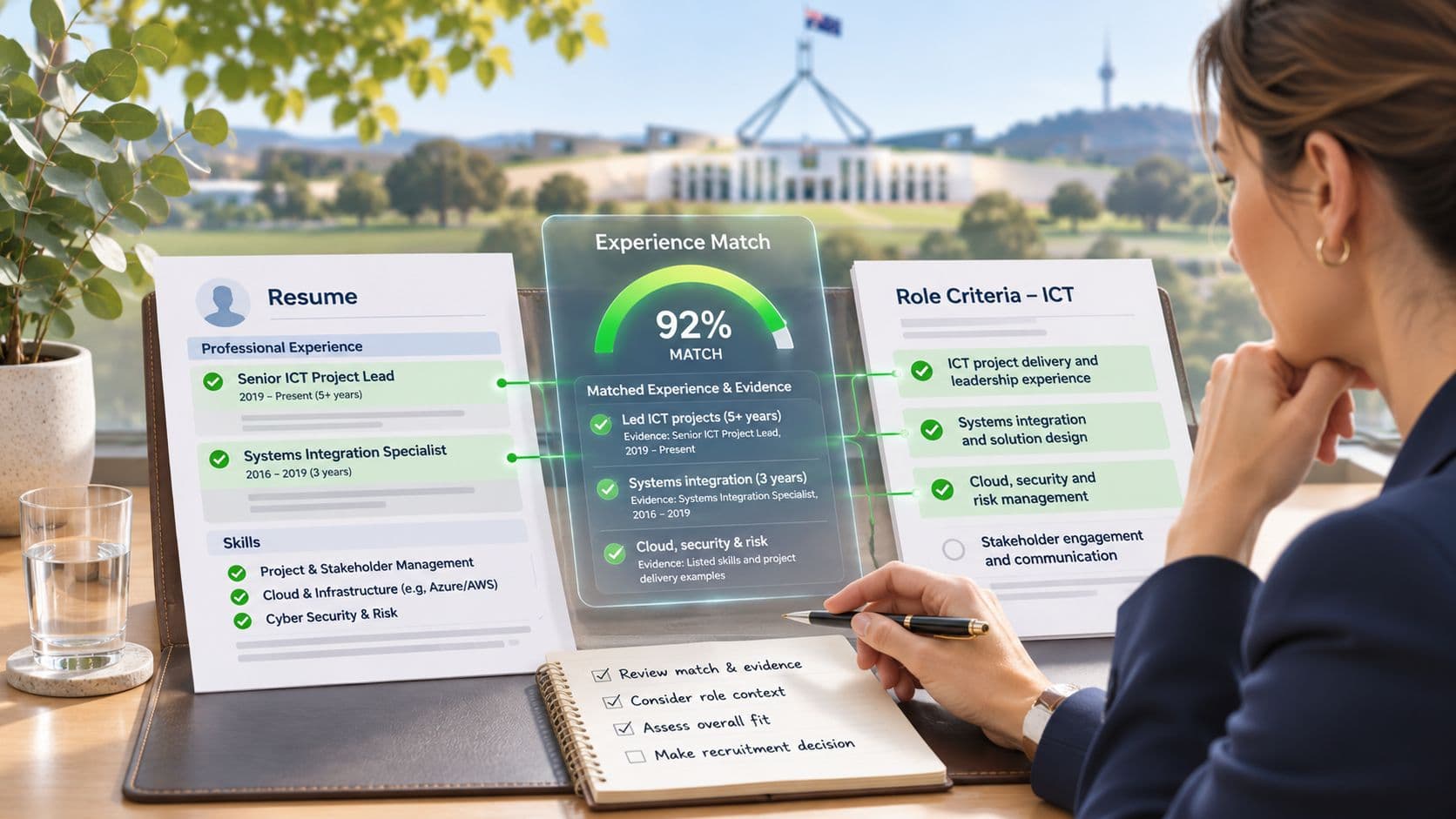
Australian employers spent an average of 9.56 days reviewing unsuitable applications for each open role, according to research commissioned by Remote covering 506 Australian businesses, reported by TelcoNews. For a recruiter shortlisting Australian Government ICT contractors, the useful question isn't whether software can produce a ranking. It's whether that ranking separates demonstrated capability from convincing wording.
A resume matching algorithm should help a person decide which candidate merits closer assessment against a particular notice. A higher score can be less defensible than a lower one if it rests on an inferred clearance, outdated availability or technical claims nobody has verified.
Table of Contents
- What a Resume Matching Algorithm Is Deciding
- How Experience and Role Criteria Become a Score
- Which Government ICT Criteria Are Hard Filters
- How Skill Claims Are Scored for Evidence
- Worked Matches for Typical ICT Roles
- When a Score Can Be Defended in Review
- Check Live Roles Against Explainable Matches
What a Resume Matching Algorithm Is Deciding
Some Australian Public Service agencies have adopted AI-assisted or automated recruitment tools, including resume scanners. Adoption alone does not show that automated rankings produce better shortlists. For a recruiter, the question is whether a recommendation can be traced to the agency's actual delivery requirements.
A useful matcher compares a candidate's experience with one specific role and gives a reviewer an ordered assessment they can accept, override or discard. For Australian Government ICT labour hire, relevant fields may include the buyer, delivery location, closing time, duties and any stated security clearance requirement. A generic occupational label cannot show whether the candidate meets those conditions.
A ranked recommendation isn't a hiring outcome
Keyword search can surface qualifications, job titles, locations and named technologies. It cannot establish, on its own, whether a contractor delivered the work the buyer needs.
Consider a resume that lists Microsoft Azure and a notice seeking experience with an Azure migration. The shared term is a useful lead, but it does not show whether the candidate delivered a comparable migration, when they did so or what their responsibilities were. The evidence behind the score matters more than a word match.
A reviewer should be able to distinguish:
- Requirement coverage: Which duties and capabilities have supporting resume evidence?
- Contextual fit: Does the experience involve comparable delivery responsibilities?
- Uncertainty: Which claims need clarification before representation or submission?
For a preliminary document check, Capstone Workforce's free resume scoring tool offers a separate resource. A general resume score can support preparation, but it cannot replace checking a government notice's conditions.
Practical rule: Identify which field changed the recommendation before considering the total score.
A higher score is less defensible when it depends on inferred, stale or unverified claims. Criterion-level evidence lets a recruiter reconstruct why a candidate matched a notice and decide whether to investigate, contact or shortlist them. The score supports that decision; it does not determine a hiring outcome.
How Experience and Role Criteria Become a Score
What each part of a match score is for
- Component — What it compares — How to use it — Review point
- Skill coverage — Skills and duties in the CV against the role's requirements — Rank candidates and retain the supporting evidence — A missing synonym does not establish that a capability is absent
- Role match — Title, seniority and type of ICT work — Assess the work and responsibility level, not title alone — Similar titles can describe different accountabilities
- Semantic similarity — Meaning across differently worded experience — Find relevant evidence for review — Similar wording is a prompt to inspect the underlying duty
- Confirmation pass — The strongest candidates against the full notice — Confirm and refine the ranking — An inferred claim can leave a high score difficult to defend
These components answer distinct questions. Skill coverage tests whether the CV supports the required capabilities. Role match considers whether the candidate has done comparable work at the relevant responsibility level. Semantic similarity can retrieve experience described in different terms, while a final confirmation pass checks the strongest candidates against the whole notice.
A score is more useful when its evidence can be reconstructed. CV matching can combine skill coverage, role match and semantic similarity, then use a final LLM scoring pass to confirm and refine the strongest candidates. Keep the signal breakdown visible: a strong vocabulary match should not conceal an unresolved requirement, and a model's confirmation should not turn an inference into a verified fact.
Use occupational similarity as a benchmark, not a hiring cutoff
The Department of Employment and Workplace Relations' occupational-transition analysis compares occupations using Australian job-advertisement information and ABS skill levels. Its relevance is methodological: it combines textual similarity with a structural constraint. It does not make an occupational transition band a candidate pass mark. The Reskilling Australia benchmark provides context for occupational transitions, not fixed cosine-similarity cut-offs for CV matching.
A cloud engineer and a technical architect may both describe Azure landing zones, identity controls and deployment architecture. Their experience can be similar in meaning while differing in accountability. Operating a platform is not, by itself, evidence of owning architecture decisions across delivery teams. The reviewer needs the duties and their context to determine what the candidate did.
The ABS-style constraint belongs to an occupational model. Applying it as an automatic exclusion to every government software engineer or technical architect shortlist would confuse occupational similarity with evidence about an individual's experience. Use it as a reference for comparing roles, then assess the CV against the notice's criteria.
Preserve the components when combining them
Set the weighting to reflect what the notice asks for. If the buyer emphasises hands-on deployment, dated implementation duties should matter more than an architecture-heavy title. The score should preserve the signals that changed the ranking, rather than presenting a total that obscures why one candidate appears stronger.
A reviewer should be able to see:
- Matched evidence: The CV sentence supporting each criterion.
- Interpretation: Whether the connection is explicit, synonymous or inferred.
- Unresolved gaps: Requirements the document does not establish.
- Reviewer action: Confirm the evidence, seek clarification or revise the ranking.
A higher score is less defensible than a lower one when it rests on inferred, stale or unverified claims. Retain those distinctions through the confirmation pass, and do not let a persuasive career narrative erase a gap. Conversely, differently worded evidence should not be discarded because initial retrieval missed the connection.
Similarity is a reason to inspect a candidate, not permission to submit them.
A match score supports a recruiter's assessment; it does not determine a hiring outcome. The decision to proceed still depends on the notice's criteria and the evidence available for each one.
Which Government ICT Criteria Are Hard Filters
Using a similarity score to resolve every requirement risks both false rejection and inappropriate submission. Hard exclusion belongs to a condition that is mandatory, verifiable and unmet, not merely absent from the parser's output.
Role criteria and how a matcher should treat them
- Criterion — Treatment — Evidence to show — Edge case
- Security clearance — Hard filter only when required and current status is verified — Level claimed and whether it is current — Baseline isn't NV1; OFFICIAL work may need no clearance
- Citizenship and sponsorship — Hard filter when the role states it — Stated eligibility, not inferred — A waiver is exceptional and doesn't guarantee approval
- Delivery location — Hard filter or review, as the notice says — City or remote claim versus delivery state — Canberra onsite isn't national remote
- Mandatory technical skill — Rank with evidence; exclude only if truly mandatory and absent — Duty, tool and recency — Related terms such as GenAI and LLM need contextual checking
- Years and seniority — Rank — Dated roles and outcomes — A career break isn't zero experience
- Government or panel context — Rank — Agency, contract or similar delivery — Private-sector delivery can still transfer
Clearance level and currency change the decision
The AGSVA applicant guide distinguishes Baseline, permitting ongoing access up to PROTECTED; NV1, permitting ongoing access up to SECRET and defined temporary access to TOP SECRET; and NV2, permitting ongoing access up to TOP SECRET. It also explains that classified information, systems or assets, or a trusted position, can require clearance, while OFFICIAL or OFFICIAL: Sensitive access doesn't by itself require one.
Don't assign a clearance requirement just because a notice concerns government cybersecurity jobs or government cloud jobs. Read the access condition. The guide to security clearance levels in Australia provides supporting context for interpreting those fields.
Currency needs its own field: AGSVA's revalidation guidance specifies Baseline every 15 years, NV1 every 10 years, and NV2 every five to seven years, with cancellation if required revalidation isn't completed. Previously held and current must remain distinct statuses.
Separate eligibility from assumptions
Applicants can't self-sponsor, and standard eligibility requires Australian citizenship and a checkable background, although a sponsoring entity may waive those requirements for an exceptional business need following risk assessment, according to the AGSVA sponsorship and eligibility guide. A waiver doesn't guarantee approval, so the matcher shouldn't manufacture eligibility from an optimistic interpretation.
Clearance also affects planning: AGSVA's published FY2024–25 fees were $884 for Baseline, $1,355 for NV1, $2,486 for NV2 and $15,280 for Positive Vetting, as recorded in its annual update. Those are dated fees, not a current quote.
For Azure, .NET, Java, Python, DevOps or Kubernetes requirements, distinguish confirmed absence from missing evidence. Route ambiguity to review; exclude only when the notice makes the requirement mandatory and the mismatch is established. The algorithm mustn't invent an exclusion the buyer didn't specify.
How Skill Claims Are Scored for Evidence
Australian job-posting analysis reported AI skills in 2.6% of all Australian advertisements and 15.5% of ICT advertisements, with mentions increasing 72.6% year on year and AI ethics and governance increasing 7.2% month on month, while separate employer research reported 97% having difficulty hiring the right AI and automation skills, as summarised by The New Daily.
That makes terminology a poor stopping point for assessment. GenAI, LLM, prompt engineering and Azure OpenAI may describe overlapping work, but they aren't interchangeable proof of capability.
Separate capability from confidence
Score presence, proficiency, recency and evidence quality independently. A strong presence signal with weak evidence quality should prompt verification, not a confident conclusion.
- Presence: Identify the described capability, including relevant alternative terminology. An LLM reference needs context before it supports a broader artificial intelligence requirement.
- Proficiency: Distinguish building, operating, advising and attending training. These describe different contributions.
- Recency: Attach the claim to dated work and compare it with any relevant experience window in the notice.
- Evidence quality: Look for a system, responsibility and outcome. Lower confidence when the resume supplies adjectives without duties.
For a vocabulary-to-duty exercise, job mapping basics from DashApply provides a supplementary starting point. Keep the government notice's actual requirements in control of the comparison.
Validate the claim, not the polish
In a Canva survey of 900 Australian respondents, 65% of Australian job applicants reported using AI to create their resumes in 2025, according to the Maitland Mercury. That doesn't establish that their claims were inaccurate; it does mean polished wording alone can't establish delivery depth.
Similarly, 26% of Australian businesses reported using AI to screen or match candidates, in reporting published in 2025 about Censuswide research commissioned by Remote in August 2024, according to KBI.Media. Automation on both sides doesn't remove the need to validate what happened.
Apply the same test to data engineering, machine learning, security architecture and Power Platform claims. Ask what the candidate delivered, when, and with what responsibility, rather than rewarding repeated technology names.
The practical application of skills-based hiring is to compare demonstrated capability without penalising unconventional titles or private-sector backgrounds. Where resumes share the same skill terms, dated, relevant outcomes should provide stronger support than an unsupported skills block.
Worked Matches for Typical ICT Roles
These hypothetical comparisons illustrate how individual fields should change a recommendation. They're not live vacancies, salary examples or claims about particular agency buying activity.
Cloud engineering with contextual terminology
The notice: A BuyICT-style cloud engineer request asks for Microsoft Azure, Kubernetes and Canberra onsite delivery. It states no classified-system requirement.
Candidate A describes Azure and AKS production migration work dated last year, using cloud-native terminology rather than repeating Kubernetes. Candidate B lists Kubernetes in a skills block without delivery dates or supporting duties.
The deciding field is implementation evidence. Rank A higher provisionally, then verify the AKS responsibilities and onsite availability. Don't invent a clearance condition for either person.
The recruiter should be able to select the migration sentence and explain its relevance. If A can't meet the stated location condition, the technical advantage doesn't resolve that separate mismatch.
Cybersecurity with an explicit access requirement
The notice: A cybersecurity contractor request requires current NV1 for SECRET systems. Candidate C declares current NV1 and describes detection-engineering delivery; Candidate D has stronger tooling experience but declares Baseline and previously held NV1.
The deciding field is current clearance status. Put D into verification rather than awarding partial clearance credit or allowing tools experience to override the requirement. C can progress on the stated information, subject to verification.
The recruiter must distinguish a resume declaration from a completed eligibility check. Neither an impressive technology list nor an earlier clearance establishes that D meets this notice today.
Architecture with transferable delivery experience
The notice: A technical architect request values government digital delivery but doesn't make previous Commonwealth work mandatory. Candidate E led a state transport platform; Candidate F has deeper vendor architecture experience and no public-sector history.
The deciding field is delivery context. Surface E's transferable stakeholder and platform responsibilities, while marking F's government-context gap for assessment rather than exclusion. The preferred candidate depends on the buyer's stated emphasis and the evidence of architectural accountability, not a title match alone.
For a separate exercise in reading role language, compare duties across JobGlance data engineer listings, then test that vocabulary against a specific Australian Government notice. Don't treat an external listing as proof of a government opportunity.
Shortlist test: The recruiter should be able to identify the sentence that moved the candidate's position and explain why it mattered to this notice.
When a Score Can Be Defended in Review
A lower evidenced score can be safer to rely on than a higher inferred score. The issue isn't whether the model sounds certain; it's whether a recruiter can reconstruct its reasoning using current documents.
The Australian Public Service Commission's 2026 recruitment principles say AI-involved recruitment decisions must be explainable and defensible, and agencies should disclose in vacancy materials how and when AI will be used. They also warn that unintended bias can arise through training and data accumulated over time.
Preserve a decision record, not just a number
For each shortlisted candidate, retain an explanation containing:
- Document versions: The role notice and resume used for that assessment.
- Criterion trail: The requirement, supporting sentences and interpretation.
- Uncertainty: Missing information, conflicting dates and confidence.
- Human judgement: Who accepted or overrode the ranking, with their reason.
A practical evidence explanation should let another recruiter understand the recommendation without having to trust the original reviewer. Keep a distinction between what the candidate wrote, what the model inferred and what someone subsequently verified.
When an opportunity or associated advertisement changes, retain the old explanation alongside the updated assessment. Replacing a shortlist without preserving its earlier basis prevents a reviewer from understanding why the recommendation changed.
Test beyond the top-ranked candidates
The Australian Government AI assurance guidance recommends quantitative fairness metrics, documented trade-offs, diverse testing and monitoring with remediation. Where lawful, privacy-compliant cohort information is available, check selection-rate ratios, false-negative-rate differences and confidence calibration rather than aggregate ranking quality alone.
Those checks answer different questions: who progresses, who is wrongly missed, and whether equivalent confidence means equivalent reliability across groups. Set acceptance criteria before changing the model, then investigate departures.
Human oversight must also reach beyond the apparent winners. Public-sector automated recruitment guidance recommends moderation or review of a sufficiently large random sample of applications and a demonstrated connection between assessed attributes and work-related qualities.
For panel-supplier labour hire, the defensibility question is concrete: could another person rebuild the shortlist rationale from the retained evidence?
Check Live Roles Against Explainable Matches
Before accepting a match, complete this check:
- Record non-inferable fields. Write down the required clearance tier and currency, delivery location, and any skill explicitly marked mandatory.
- Confirm the notice is actionable. Check that the opportunity remains open and read its closing conditions rather than relying on a saved copy.
- Inspect the explanation. Read supporting sentences, missing fields and confidence before contacting or shortlisting a candidate.
- Record your judgement. Keep the role version, resume version and reason whenever you override the recommendation.
At erecruit, our CV matching extracts skills and security clearance from a resume, scores each candidate against BuyICT opportunities and shows the evidence behind each score. A user who uploads a resume is notified the moment a matched BuyICT opportunity goes live.
Treat that result as discovery support, not a submission decision. Our service doesn't guarantee a placement or commercial outcome; the recruiter still needs to validate claims and confirm the candidate can be represented.
Start with a live notice and a real resume. Check whether each important requirement has explicit support, whether uncertainty is visible, and whether you can explain your decision without referring only to the total score.
Visit erecruit to discover Australian Government ICT jobs, contracts and procurement opportunities, and compare a CV with role-specific evidence. Upload a resume, inspect a matched opportunity's clearance and location requirements, and use the explanation to decide which candidate deserves your next verification call.