

7 Approval Workflow Example Templates for Government ICT
Seven approval workflow example steps behind Australian Government ICT jobs, panels and security clearances, with what recruiters should track in 2026.
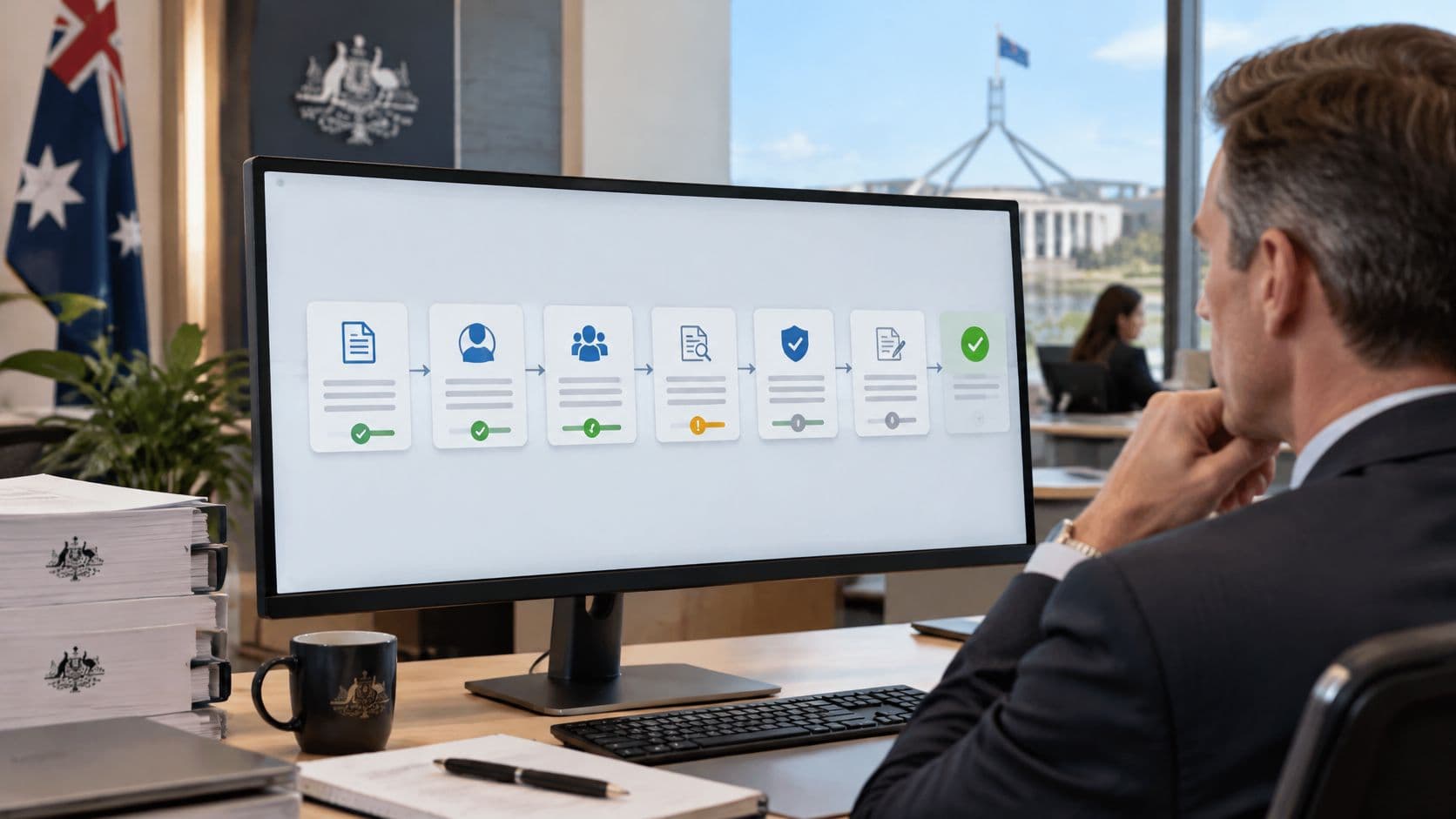
A procurement request can reach the market before its approval record is complete. In an examination of Department of Foreign Affairs and Trade procurement through its Australian Passport Office, the Australian National Audit Office found that delegate approval preceded the approach to market in only 38 of 62 applicable procurements. For a recruiter, an advertised requirement isn't enough evidence that every approval needed for engagement is in place.
Australian Government ICT placements depend on decisions made by project owners, procurement delegates, security teams, panel suppliers and candidates. Those decisions answer different questions. A funded program isn't an approved contractor engagement, and a technically suitable candidate isn't necessarily cleared or authorised for submission.
Recruiter's rule: Treat an advertisement as a sourcing signal, not permission to promise a start date.
Each approval workflow example below separates the hiring signal, the decision that can block progress, and the evidence to verify before submission. These are recruiter-side templates, not substitutes for an agency's current procurement, security or employment procedures.
Use them for Australian Government software engineer jobs, cloud and DevOps contracts, cybersecurity roles, data and AI opportunities, and ICT project delivery engagements. The practical question stays the same: who still needs to approve what before this candidate can proceed?
Table of Contents
- 1. DTA Digital Investment Oversight and Gateway Review Workflow
- 2. IRAP Assessment and ISM-Based System Authorisation (Authority to Operate)
- 3. Security Clearance Sponsorship and Vetting Workflow (PSPF)
- 4. Commonwealth Procurement Approval Through Delegations
- 5. ICT Panel Supplier Onboarding and Call-Off Approval
- 6. Contractor Engagement and Hiring Approval Workflow
- 7. ICT Change Advisory Board (CAB) Approval Workflow
- How each Australian Government ICT approval workflow affects recruiters
- Turning Approval Stages Into Earlier Placement Decisions
1. DTA Digital Investment Oversight and Gateway Review Workflow
A digital modernisation announcement is a reason to investigate, not evidence that an agency has approved a delivery role, issued a labour-hire request or selected a supplier. For recruiters, investment oversight signals where opportunities may emerge. It does not confirm that a candidate can be submitted or start.
The Digital Transformation Agency's ICT Investment Approval Process applies to digital and ICT-enabled proposals with whole-of-life costs of at least AUD 30 million, including at least AUD 10 million in ICT costs, that are either Cabinet-bound or high risk. This pathway does not apply to every government ICT vacancy. Investment approval, assurance and procurement are related, but each is a separate decision.
Translate investment stages into sourcing decisions
Track the recruiter-side sequence: identify the program → establish approval maturity → locate the procurement request → verify the role and supplier → qualify candidates. Record evidence at each stage. A program's progress is not proof that a specific role is approved.
- Program owner: Identify the agency and business area responsible for delivery.
- Investment status: Separate planning or business-case activity from an authorised sourcing requirement.
- Procurement connection: Locate the request or contract supporting the advertised position.
- Role evidence: Record the skills, clearance, location and timing specified in the current requirement.
For example, published plans to consolidate cloud platforms are a hiring signal to monitor for cloud architecture, migration and cybersecurity roles. They do not show that an Azure architect's engagement is ready to start.
When a labour-hire request appears, compare its scope with the supplier's advertisement. The same cloud program may require architecture, engineering, assurance and project management, each with different approval dependencies.
The hiring signal is a traceable delivery requirement. The remaining blocker may be investment progression, procurement authority or approval of the individual engagement. Ask the supplier which decision is outstanding, and keep any proposed start date conditional until the answer is documented.
2. IRAP Assessment and ISM-Based System Authorisation (Authority to Operate)
Say a panel supplier advertises for a cloud security engineer to support a new platform. Before matching candidates, establish whether the assignment involves preparing assessment evidence, resolving security findings or operating an already authorised environment. Those are different jobs.
Keep IRAP assessment, Information Security Manual alignment and system authorisation separate in the role record. An assessment deliverable shouldn't be recorded as an agency's final authorisation decision. Confirm the applicable process, current ISM expectations and decision owner with the agency's security contact rather than inferring them from an advertisement.
Build the template around the security decision
For recruiter tracking, use system scope confirmed → assessment requirements identified → evidence prepared → findings reviewed → authorisation decision recorded → operating conditions confirmed. The agency must confirm its actual sequence and who can accept residual risk.
A useful government example appears in a Department of the Prime Minister and Cabinet AI-access process: a request passes through architecture and security considerations, a CIO decision and policy review before procurement proceeds. That illustrates why technical review and final permission should remain distinct; it isn't evidence of a universal system-authorisation procedure.
For the cloud security engineer, capture:
- Required output: Assessment documentation, control implementation, remediation or operational support.
- Decision dependency: Whether system authorisation affects production access or only a later delivery milestone.
- Candidate evidence: Specific responsibilities on comparable systems, not just an IRAP keyword.
- Security context: The clearance requirement stated for the person, separately from the platform's assessment status.
A system's security assessment doesn't establish an individual candidate's clearance or permission to access it.
The hiring signal may be a need to prepare authorisation evidence. The start blocker may instead concern access to the environment. Ask which activities the contractor can perform before authorisation, and don't turn an unresolved technical milestone into an unsupported onboarding promise.
3. Security Clearance Sponsorship and Vetting Workflow (PSPF)
Clearance required, clearance claimed and clearance confirmed for the engagement belong in different fields. Combining them makes it difficult to distinguish a sourcing problem from an onboarding dependency.
Build the workflow around the sponsoring agency's current Protective Security Policy Framework requirements and the relevant vetting process. Ask the agency or supplier to confirm the required clearance, sponsorship arrangements and acceptable evidence. Don't infer eligibility, transferability or processing time from a candidate's CV.
Separate the role requirement from the candidate's status
A practical tracking sequence is requirement confirmed → candidate status recorded → sponsorship position established → vetting or verification status checked → access and commencement conditions confirmed. Record who supplied each answer and when it was checked.
- Role requirement: Copy the stated Baseline, NV1 or NV2 requirement accurately.
- Candidate statement: Record what the candidate says they hold, without presenting it as independently verified.
- Verification owner: Identify who is authorised to confirm suitability for the engagement.
- Outstanding action: State whether sponsorship, vetting, verification or access approval remains unresolved.
For a terminology comparison, use the guide to NV1 versus Baseline clearance, then verify the specific vacancy's conditions. A general explanation can't determine what an agency will accept for an individual contract.
Say a software engineering advertisement specifies NV1, while a candidate's CV lists Baseline. Keep that candidate out of the submission-ready shortlist unless the supplier confirms an acceptable pathway for this requirement. Strong Java, .NET or Python experience doesn't resolve the clearance mismatch.
Conversely, don't assume every role within the same digital program needs the same clearance. Check the individual request.
The hiring signal is a role with an explicit security requirement. The potential blocker is the unresolved sponsorship, clearance or access decision. Keep the proposed start date conditional where that decision remains open, and don't promise a vetting timeframe that hasn't been confirmed through current official guidance.
4. Commonwealth Procurement Approval Through Delegations
A hiring manager's preference isn't the same as authority to commit agency funds. Recruiters need to establish both who wants the contractor and who can approve the engagement.
The Department of Finance's procurement guidance provides the Commonwealth context for purchasing decisions. For a live opportunity, confirm the applicable Commonwealth Procurement Rules, the entity's financial delegations and its procedures under the Public Governance, Performance and Accountability Act 2013. Don't borrow a threshold or approval route from another agency's contract.
The distinction matters across a substantial procurement market: Australian Government agencies published 86,926 contracts with a combined value of A$104.90 billion in 2024–25, according to the Department of Finance's procurement statistics. Those figures cover government procurement generally, not ICT recruitment alone.
Record the decision, not just the activity
Use requirement defined → procurement route confirmed → evaluation completed → delegate decision recorded → contract issued → commencement conditions checked as the tracking template. Adjust it to the agency's actual process.
A recruiter's evidence record should distinguish:
- Business need: The hiring manager's approved scope and role requirements.
- Purchasing route: The tender, panel arrangement or other confirmed procurement mechanism.
- Financial decision: The authorised decision covering the proposed engagement.
- Contract status: Whether the relevant contract or work order has been issued.
Say a manager selects a technical architect after interview but still needs approval for the proposed rate. Record the candidate as selected, with rate approval outstanding. Don't mark the engagement ready to start just because the interview outcome was positive.
Approval evidence: Store the decision owner, decision date, approved scope and any conditions. An email saying someone is chasing approval isn't the approval.
The hiring signal is an authorised requirement progressing through sourcing. The blocker may be a delegate decision, unresolved commercial condition or unissued contract. Ask which one applies before negotiating candidate availability around a firm date.
5. ICT Panel Supplier Onboarding and Call-Off Approval
Panel membership and an individual contract award are separate approvals. Verify both before treating a supplier's advertisement as a confirmed route into an agency engagement.
Under BuyICT's Digital Marketplace 2 ICT Labour Hire arrangement, an approved seller identifies a suitable candidate; if the buyer accepts that candidate, the seller employs or engages the person and supplies them under contract. The buyer's selection and the supplier's engagement responsibilities therefore need separate tracking.
Follow the buyer-to-supplier chain
Use supplier eligibility verified → buyer request identified → advertisement matched → candidate evaluated → buyer decision recorded → supplier engagement confirmed. Keep the request reference alongside the advertisement so another recruiter can inspect the connection.
BuyICT's buyer guidance describes procurement planning, sourcing and evaluation against role requirements, including the use of the APS Job Family Framework. For recruiters, that means matching against the buyer's criteria, not only the supplier advertisement's technology keywords.
Say a panel supplier advertises for a React developer. Compare the buyer request and advertisement for clearance, location, required skills and submission timing. A similar title isn't enough to establish that they concern the same opportunity.
- Supplier check: Verify the relevant arrangement and the supplier's role in the proposed engagement.
- Requirement check: Resolve differences between the request and advertisement before presenting a candidate.
- Authority check: Confirm who can submit the candidate and who will employ or engage them.
The government staffing agency guide provides context for evaluating that supplier relationship. General supplier onboarding guidance for procurement teams can help organise supplier documentation, but it doesn't replace BuyICT's arrangement-specific conditions.
The hiring signal is a current buyer request connected to a verified supplier. The blocker may be buyer acceptance or the supplier's outstanding contract. Recheck the linkage if the supplier, role scope or submission destination changes.
6. Contractor Engagement and Hiring Approval Workflow
Candidate consent is an approval in its own right. A recruiter's decision that someone fits an Australian Government ICT role doesn't authorise representation to a particular supplier or buyer.
In the Office of the Australian Information Commissioner's community attitudes findings, 69% of Australians favoured a clear and specific purpose for data collection, while 68% favoured the ability to opt in or consent. These findings support explicit purpose and permission records; they aren't a substitute for assessing the privacy obligations that apply to a recruitment business.
The engagement sequence below should distinguish agency decisions from recruiter and candidate decisions.
Keep representation approval specific
Use role and budget confirmed → candidate qualified → representation consent recorded → submission authorised → buyer selection recorded → commercial terms approved → security conditions checked → onboarding confirmed. Some reviews may run in parallel, but each decision needs its own evidence.
Say a supplier changes a Python data engineering role from the original requirement to a materially different assignment. Reconfirm the candidate's interest and representation permission before submitting the cached CV. Previous permission shouldn't become approval for every subsequent opportunity.
Record:
- Consent scope: The role, supplier, destination and CV version covered.
- Decision evidence: Who approved representation, when and subject to what conditions.
- Reconfirmation triggers: Material changes to duties, clearance, location or submission destination.
- Withdrawal status: A visible instruction preventing further submission where permission has been withdrawn.
Use the onboarding process guide to distinguish preparation from confirmed commencement. A completed onboarding form doesn't establish that budget, contract or security decisions are complete.
The hiring signal is an approved requirement with a suitable, interested candidate. The start blocker may sit outside recruitment altogether. Keep consent, buyer acceptance, contract execution and commencement readiness separate so the team can identify the actual unresolved decision.
7. ICT Change Advisory Board (CAB) Approval Workflow
Say a government DevOps role requires a Kubernetes platform upgrade. A candidate who can write deployment scripts may still lack the experience needed to document impact, present a change for review or prepare a usable rollback plan.
For a recruiter-side Change Advisory Board approval workflow example, track change proposed → impact and risk assessed → testing evidenced → approval route confirmed → implementation authorised → outcome reviewed. Ask the agency whether it uses a CAB, an ITIL-aligned process or an internal framework. Don't assume every deployment requires the same review.
Match candidates to the change process
Distinguish the person who prepares a change from the person or body authorised to approve it. A DevOps engineer may supply the technical evidence without holding authority to release into production.
- Change preparation: Ask how the candidate documents dependencies, service impact and implementation steps.
- Testing evidence: Ask what results they provide before requesting approval.
- Rollback planning: Ask how they define recovery actions and the point at which to stop.
- Operational review: Ask how they record outcomes, incidents and follow-up work.
The APS Data, Digital and Cyber Workforce Plan 2025–30 identifies more than 7,500 digital professionals in the APS, including software engineering and technology architecture roles. For contractor matching, technical capability should therefore be described precisely rather than reduced to a broad government technology label.
For a Microsoft Azure operations assignment, establish whether the contractor will prepare changes, implement approved changes or manage the change process itself. Ask separately about routine pre-authorised work and changes requiring specific review.
The embedded video provides additional viewing alongside the agency-specific process discussion.
The hiring signal is a defined operational responsibility. An implementation approval may block a release without blocking the contractor's engagement. Keep those dates separate, and verify whether the vacancy depends on an upcoming change window or supports ongoing operations.
How each Australian Government ICT approval workflow affects recruiters
- Item — Who Approves — Stage Recruiters Can See — Clearance Impact — Check Before Submitting
- DTA Digital Investment Oversight and Gateway Review Workflow — Agency accountable authority; DTA provides assurance advice — Published project information and procurement plans; review timing may not be public — No direct clearance decision; funded projects may create roles with security requirements — Check current DTA thresholds and review requirements; verify project funding and role linkage
- IRAP Assessment and ISM-Based System Authorisation (Authority to Operate) — Agency Authorising Officer grants the ATO; IRAP assessor evaluates where required — Assessment and authorisation status may be available through project or role details — System risk and data classification can shape required clearance and security skills — Confirm the role's security requirements and relevant ISM or IRAP experience
- Security Clearance Sponsorship and Vetting Workflow (PSPF) — Sponsoring agency confirms need; vetting authority assesses suitability — Sponsorship and vetting status, subject to agency and vetting processes — Determines required clearance level and whether the candidate can start — Confirm required level, candidate status, eligibility, and current vetting guidance
- Commonwealth Procurement Approval Through Delegations — Officials with financial delegations under agency rules — Published tenders and some contract details; panel call-offs may be less visible — No direct clearance decision; contract requirements may specify clearance — Check current procurement rules, contract details, and relevant panel or tender
- ICT Panel Supplier Onboarding and Call-Off Approval — Agency evaluates responses and approves call-offs within delegations — Panel call-off, supplier response, and contract or work order stage — Role-specific clearance requirements may be set in the call-off — Verify the panel, supplier, role requirements, and contract-to-ad linkage
- Contractor Engagement and Hiring Approval Workflow — Hiring manager and financial delegate; security, HR, or procurement teams handle their respective approvals — Role, budget, rate, clearance, and onboarding approval stages — Clearance confirmation can be required before onboarding or start date — Confirm approval stage, clearance requirement, and candidate representation consent
- ICT Change Advisory Board (CAB) Approval Workflow — Agency Change Advisory Board or designated change authority — Change request review, approval, scheduling, and post-implementation review — No direct clearance decision; security-sensitive work may require relevant access or skills — Check required change-management experience and the agency's CAB process
Turning Approval Stages Into Earlier Placement Decisions
Each workflow creates a point where a candidate can be ready, blocked or no longer relevant. The recruiter's job is to identify the outstanding decision, the person authorised to make it and the evidence needed to proceed. That gives candidate conversations a firmer basis than an advertisement alone.
Start with the opportunity rather than the CV. Confirm the buyer requirement, panel supplier and current role scope before investing heavily in a shortlist. Then assess technical fit, clearance evidence, representation consent and availability against that specific opportunity.
Separate readiness from selection
A useful record should let another recruiter answer these questions without reconstructing an email chain:
- What is approved? Identify whether the decision concerns investment, procurement, the role, the candidate or commencement.
- What remains conditional? Name the unresolved budget, security, commercial or access decision.
- Who owns the next action? Assign the follow-up to a named recruiter, supplier contact or agency decision owner.
- What changed? Preserve revisions to the requirement and identify whether they require renewed qualification or consent.
Don't turn every outstanding action into a single pending status. A candidate awaiting buyer selection needs different follow-up from one awaiting security confirmation. A selected candidate with an unissued contract shouldn't receive the same commencement message as someone whose engagement is complete.
Measure approval quality as well as progress. Track whether approval occurred before submission, whether the supporting evidence is complete and whether changed requirements triggered review. A fully populated pipeline can still contain candidates who shouldn't yet be submitted.
Use matching without delegating approval
eRecruit.io is an Australian platform for discovering Australian Government ICT jobs, contracts, tenders and procurement opportunities. Our contract-to-ad linking connects procurement opportunities with panel-supplier advertisements using role, clearance, location and timing evidence, while our pipeline tracks candidates from unqualified to placed and gates submission on recorded representation consent.
Treat a match score as qualification support, not approval to represent a candidate or promise engagement. The responsible people still need to confirm the requirement, permission and outstanding agency decisions. Automated matching is most useful when it directs attention to evidence that a recruiter can review.
Before the next shortlist, check approval stage, clearance requirement and panel linkage. If any remains uncertain, record the gap and assign the follow-up rather than filling it with an assumption. That makes the next placement decision clearer for the recruiter, supplier and candidate.
Our platform helps you connect Australian Government ICT procurement opportunities to live supplier advertisements, review CV-match evidence and track consent before submission. Visit erecruit, sign up, upload a CV and let the matcher surface relevant opportunities for your next approval-stage review.